The PSD Knowledge Center
Particle size distribution is the one idea that ties the whole removal train together — what size your solids are, which machine owns each band, and why the curve, not the retort alone, tells you where your dilution is going.
1What is PSD?
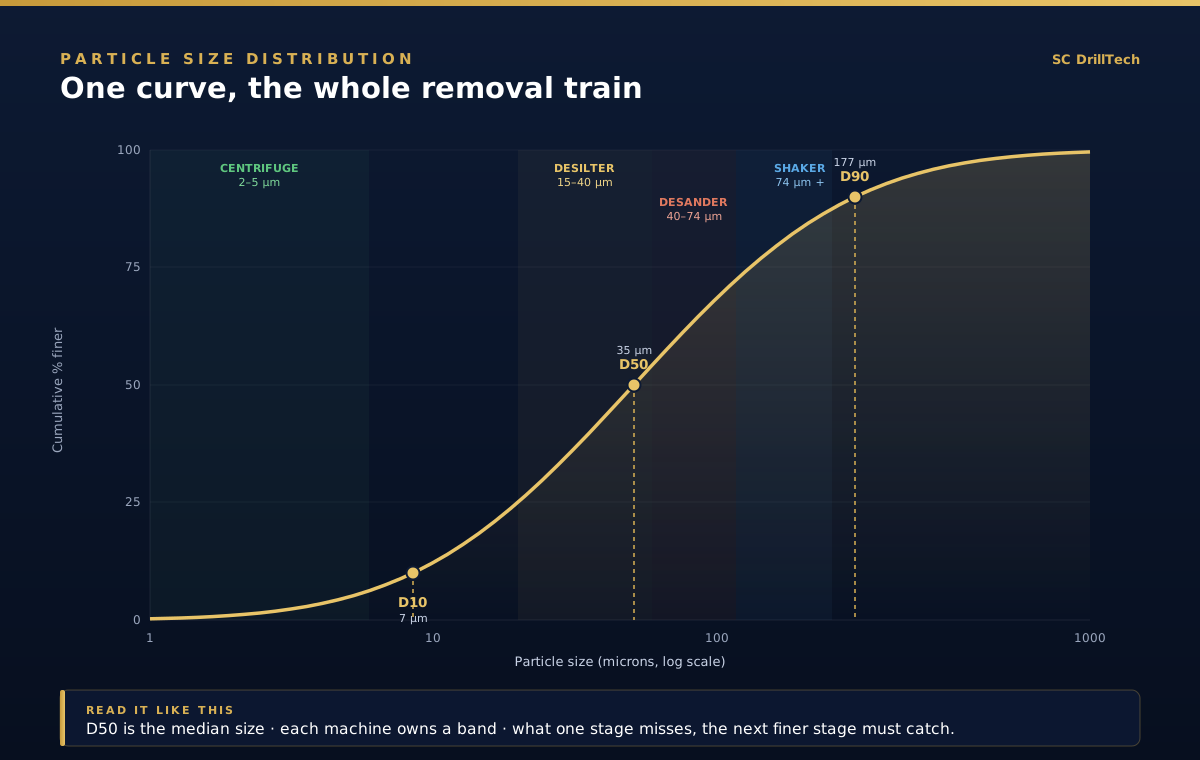
Particle size distribution (PSD) is the full picture of what sizes of solids your mud is actually carrying — not one number, but the whole spread, from colloidal clay below 2 µm to coarse cuttings above 100 µm. Every screen cut, every cone, every centrifuge setting is a statement about where on this curve you are trying to cut. Read the PSD and the whole removal train stops being a row of machines and becomes one coherent system: each stage owns a size band, and what one stage misses, the next finer stage must catch — or dilution pays for it.
2D10, D50, D90, D100 explained
PSD is read at percentile points — the size below which a given fraction of the solids lies:
| Value | Means | Tells you |
|---|---|---|
| D10 | 10% finer | The fine tail — colloidal / reactive load the centrifuge fights. |
| D50 | 50% finer (median) | The middle of the distribution — the single most-quoted size. |
| D90 | 90% finer | The coarse end — what the shaker and desander should be catching. |
| D100 | 100% finer | The largest particle present — the screen cut point (API RP 13C). |
A useful habit: a tight distribution (D10 and D90 close together) is easy to cut cleanly; a wide one (fines and coarse together) means no single stage can do the job — you need the whole train.
3PSD vs the retort
PSD and the retort measure different things — they are complementary, not rivals. The retort (API RP 13B-1/13B-2) tells you how much solid is in the mud by volume (oil / water / total solids), and with mud weight you split that into barite and low-gravity solids. PSD tells you what size those solids are. One is quantity; the other is size.
You need both. The retort says “you have 18% solids and your LGS is climbing”; the PSD says “and they are fine — D50 has dropped to 20 µm, so the shaker can’t touch them; this is a centrifuge job.” Together they tell you not just that you have a solids problem, but which machine owns it.
4PSD vs dilution
Dilution is the most expensive lever on the rig, and PSD tells you when you are being forced to pull it. As the distribution shifts finer — D50 falling, the fine tail growing — mechanical removal gets harder: the solids are now below the cut point of every stage except the centrifuge. If the centrifuge can’t keep up, the only fast lever left is dilution, and the curve is telling you why your dilution rate is climbing.
The lesson: catch solids coarse and early, before they grind finer on every circulation and migrate down the curve into the colloidal range that only dilution and the centrifuge can chase. A rising fine tail is a dilution bill forming.
5PSD vs centrifuge performance
The centrifuge is the only stage that reaches the fine end of the curve — and PSD is how you prove it is working. A centrifuge that is genuinely cutting shifts the whole distribution coarser: it strips the fines, so the curve moves right and climbs later. No shift means no separation — the machine is running but not cutting (often poor recovery or wrong duty).
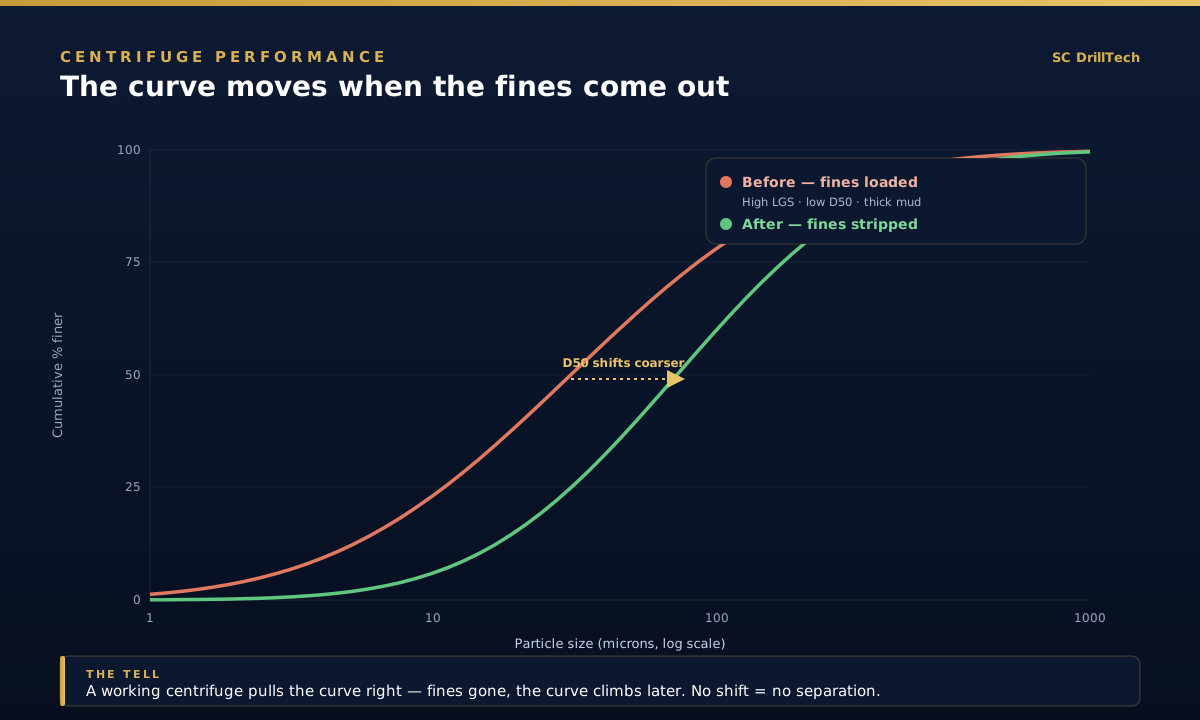
Compare a feed-vs-effluent PSD across the bowl and you have a direct, defensible measure of the cut point — see the decanting centrifuge guide for the duty settings that move it.
6Fine solids & LGS
Low-gravity solids (LGS) and the fine end of the PSD are the same enemy seen two ways. The fines that build at the D10 end are the drilled solids the equipment failed to catch while they were coarse — ground finer on every circulation until they disperse into colloidal clay (rising MBT) that no screen or cone can touch.
This is why PSD is a leading indicator: the fine tail starts growing before plastic viscosity and dilution confirm the problem. Watch the bottom of the curve and you catch the fines while the centrifuge can still take them — wait for the retort and you are already diluting.
7PSD interpretation guide
Reading a PSD in the field comes down to a few questions:
- Where is D50? Falling tour over tour = fines accumulating; the train is slipping.
- How fat is the fine tail (below D10)? A growing tail is a centrifuge / dilution problem forming.
- Is the coarse end (D90+) where it should be? Coarse solids surviving means a shaker bypass or a screen too coarse.
- Did the curve shift after the centrifuge? No shift = no separation.
Match the symptom to the stage: coarse survivors → shaker / desander; mid-range building → cones at low head; fine tail growing → centrifuge duty or hours.
8PSD case studies
Case — the dilution that PSD explained. A mud thickening with dilution climbing, retort solids “only” at 17%. The PSD showed D50 had fallen from 45 to 22 µm over the section with a fat fine tail — the solids were now below every cut except the centrifuge, which was running six hours a day. The fix was not chemistry: it was centrifuge hours, not dilution.
Case — the coarse survivors. Sand content low, yet abrasion wear high. The PSD’s coarse end (D90) sat well above the shaker cut — a holed panel was passing coarse solids the sand test, sampled elsewhere, never saw. The curve found what a single number hid.
Cases are illustrative of the method, not specific wells.
→Go deeper
Want your PSD read against the train?
Send your particle-size and retort data — SC DrillTech will map it against each stage’s cut band and tell you which machine owns your fines.
Put these numbers to work on your rig
Send your shift data — we read it against API RP 13C and tell you exactly what to change.
Request a remote evaluation →