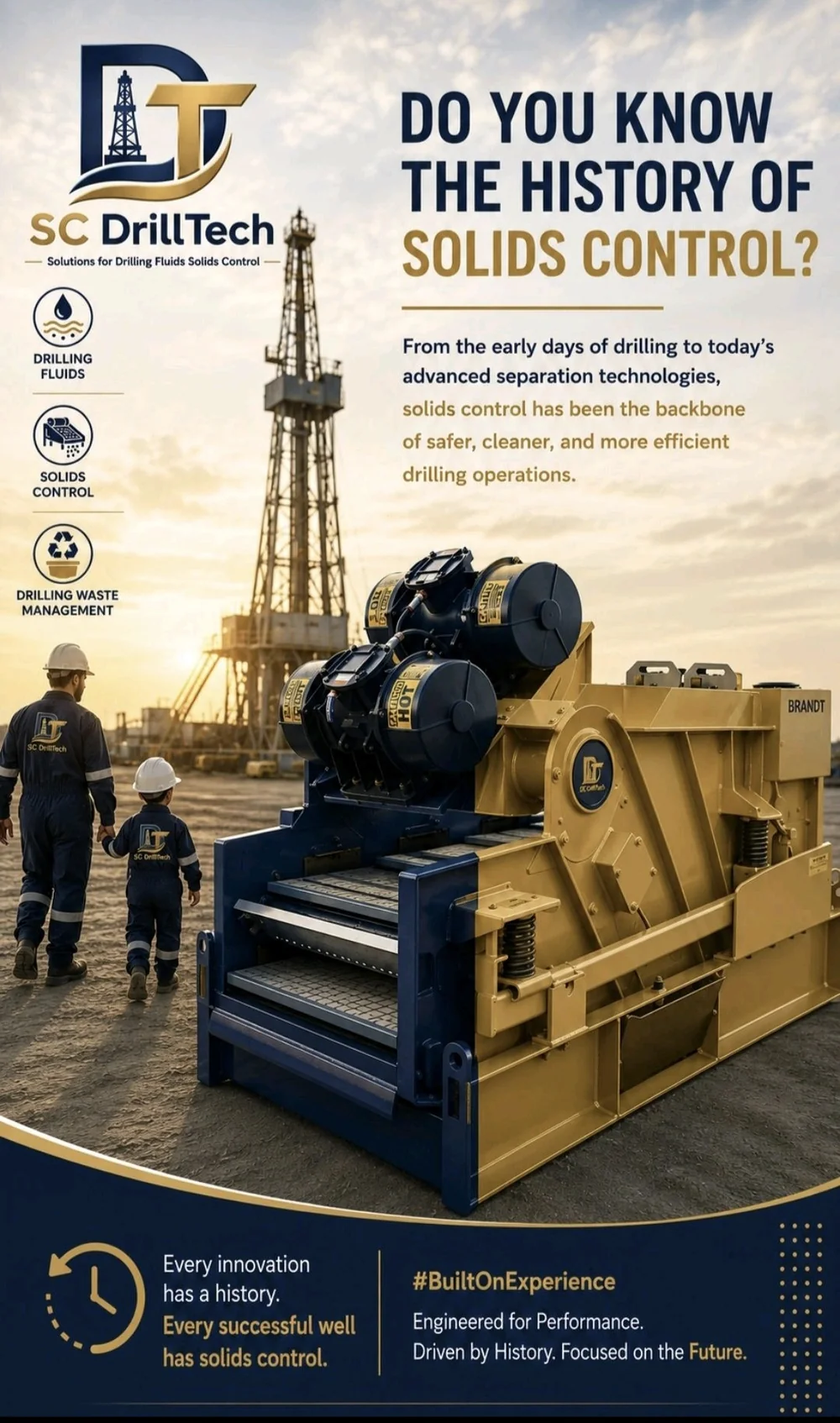
Most people assume solids control started on a drilling rig. It didn’t. The equipment standing on your shaker deck today is the end of a long chain of borrowed, adapted and hard-won engineering — a story of solving the same problem under ever more extreme conditions. Knowing where it came from explains why it works the way it does.
Before the mud engineer
Until around 1930, the job title “mud engineer” did not exist. Drilling crews judged their fluid almost entirely by hand and by eye — feel, taste, look — with rule-of-thumb methods passed down on the rig floor. The very first solids control was not a machine at all: it was a series of settling pits and weirs that let the heavier solids drop out of the mud by gravity before the cleaned fluid was pumped back down the hole. Slow, crude, but the principle — separate the solids from the fluid — has never changed since.
Borrowed technology
The breakthroughs came from outside the oilfield. The first shale shaker was adapted from vibrating-screen technology used in the mining industry and appeared in oilfield use in the early 1930s. It remains, almost a century later, the first line of defence on every rig.
The hydrocyclone followed a similar path — the cone classifier was borrowed from mineral processing and sand-separation work, where spinning a slurry to throw solids outward by centrifugal force was already well understood. Adapted to drilling fluid, it became the desander and desilter. No moving parts, just geometry and pressure: the same machine you run today.
The rise of the mud engineer
As wells got deeper and fluids more sophisticated, the mud stopped being something the crew mixed by instinct and became a designed system with measured properties. The 1930s saw the birth of the mud engineer as a profession — and with it, the idea that drilling fluid is engineered, monitored and controlled, not just stirred. Solids control and mud engineering grew up together, because you cannot control fluid properties without controlling the solids in them.
Finer and finer
The decanting centrifuge brought the finest cut of all. It was adapted from industrial high-speed solid–liquid separation — the same broad family of centrifugal technology that advanced rapidly through mid-twentieth-century industry and research — and gave drilling its first practical way to recover expensive barite and to strip the ultra-fine, low-gravity solids that no screen or cone could catch. It sits at the end of the train to this day, doing the job nothing upstream can.
The one principle that never changed
For all the technological evolution — from settling pits to high-G shakers, from cone classifiers to variable-speed centrifuges — one engineering truth has held since the very first weir:
A solid you catch coarse and early, at the shaker, is cheap to remove. The same solid, missed and ground finer on every circulation, disperses into colloidal material that thickens the mud, forces dilution, and can only be chased with the centrifuge or with fresh fluid. The history of the equipment is really the history of catching solids earlier and finer.
Where the losses really are
Which leads to the lesson that ties the whole story together — and that still surprises people. Sometimes the biggest drilling losses are not happening downhole. They are happening on the surface — in the dilution you build, the fluid you discard, and the waste you haul, every time the separation train runs below its potential. The crews of 1930 understood the principle with a settling pit. The only thing that has changed is how precisely we can now measure it.
From history to real time
That measurement is where the story is heading next. The same field that began by judging mud by hand is moving toward real-time monitoring of cuttings, particle-size distribution and shaker load — turning a century of hard-won field judgement into data you can act on tour by tour. Every innovation has a history; every successful well has solids control.
Key takeaways
Solids control is older, broader and more borrowed than most engineers realise — a continuous line of adaptation from settling pits to today’s separation train. But the founding principle is unchanged: catch the solids early and at the surface, because that is where the well is quietly won or lost.