By Othman Soliman — Solids Control & Drilling-Waste specialist, 26+ yrs (GCC & MENA). Last reviewed .
Drilling waste management is where recovered value and environmental compliance are won or lost — the chain from cuttings collection through the cuttings dryer and dewatering to the disposal route. This is the deep reference: the transfer chain, the vertical cuttings dryer (VCD), the dewatering centrifuge and its chemistry, and the oil-on-cuttings, segregation and disposal-route failures that turn waste handling into a compliance problem.
Where it sits: downstream of solids control, taking the wet cuttings the shakers, hydrocyclones and centrifuge discard and treating them to recover fluid and meet disposal limits. Solids control typically discards one to four barrels of liquid per barrel of solids — DWM is how that value is recovered and how oil-on-cuttings is driven to spec.
DWM begins where solids control ends — moving wet cuttings from the shakers, desander, desilter and centrifuge to treatment. The transfer chain (screw conveyors/augers, vacuum units, rotary-lobe pumps) is abrasive, plug-prone, and the first place a waste system fails.
Screw conveyor (auger) flight wear and jamming
Mechanism
Augers move cuttings from the shakers/centrifuge to the dryer; their flights wear in the abrasive solids and jam on oversize debris or packed cuttings.
Shows as
Falling transfer capacity, jamming, motor trips; cuttings backing up under the shakers.
Detect / inspect
Inspect flights (tungsten-carbide-faced) for wear; check for jams and debris; trend drive current.
Consequence downstream
Cuttings back up and overflow at the shakers; the whole waste chain stalls.
Correction
Hard-face/replace flights; remove oversize debris; size the auger for the load; maintain the drive.
Vacuum / rotary-lobe transfer unit failures
Mechanism
Vacuum units and rotary-lobe solids pumps move cuttings where augers can't; they lose vacuum, wear, or plug.
Shows as
Lost transfer, plugging, can't keep up with cuttings rate.
Detect / inspect
Check vacuum/pump performance; inspect for wear and blockage.
Consequence downstream
Cuttings accumulate; treatment starves.
Correction
Maintain the vacuum/pump; clear blockages; size for the cuttings rate and distance.
Transfer route plugging / bridging (wet, sticky cuttings)
Mechanism
Wet, sticky or gumbo cuttings bridge in chutes, augers and lines.
Shows as
Bridging and blockages in the transfer route.
Detect / inspect
Inspect chutes/lines for bridging; correlate with cuttings wetness/type.
Without interim holding (cuttings skips, holding tanks/CSTs), surges in cuttings rate overflow the system.
Shows as
Overflow and spillage on connection surges or high ROP.
Detect / inspect
Check holding/skip capacity vs peak cuttings rate; watch for overflow.
Consequence downstream
Spillage, HSE and containment failures.
Correction
Provide interim holding/skip capacity for peak rate; manage skip change-out logistics.
Cuttings dryer (VCD) failures
The vertical cuttings dryer (VCD) is a high-G vertical screen centrifuge: a screen bowl spins (commonly ~900 rpm, several hundred G) and throws liquid through the screen while hardfaced flights scroll the dried solids out. It recovers fluid and drives oil-on-cuttings down — and it's the most failure-rich unit in the waste chain.
Screen bowl (basket) blinding / wear
Mechanism
The screen bowl traps solids and passes liquid; it blinds with fine/sticky solids and wears in the abrasive duty.
Shows as
Wet discharge, poor fluid recovery, high OOC; rising vibration as it wears.
Detect / inspect
Inspect the screen bowl for blinding and wear (top observation port); sample discharge OOC and recovered fluid.
Consequence downstream
Fluid lost in the cuttings, high oil-on-cuttings (compliance), and imbalance.
Correction
Clean/replace the screen bowl; use the air knife to prevent blinding; manage feed; replace worn baskets.
Flight (scroll) wear — loss of the bowl/scroll gap
Mechanism
Hardfaced flights scroll solids out slightly slower than the bowl; wear opens the critical bowl–scroll gap and ruins operation.
Shows as
Poor solids discharge, wet cake, vibration; gap out of spec.
Detect / inspect
Inspect flight hardfacing and the bowl–scroll gap at maintenance.
Consequence downstream
Poor drying and recovery; mechanical damage.
Correction
Re-tip/replace flights (tungsten carbide); reset the gap to spec; protect with hardfacing.
Air knife failure (screen blinding control)
Mechanism
An air knife cleans the screen to prevent blinding; if it fails, the screen blinds.
Shows as
Progressive blinding, wet discharge.
Detect / inspect
Check air-knife air supply and operation; inspect the screen.
Consequence downstream
Poor drying and fluid recovery.
Correction
Restore the air-knife supply; maintain it; keep the screen clean.
Like any centrifuge, the high-G VCD rotor fails on bearings and imbalance.
Shows as
Rising vibration, noise, heat; trips; risk of major failure.
Detect / inspect
Vibration and bearing-temperature monitoring; check balance and the screen for uneven build-up.
Consequence downstream
Catastrophic failure and downtime.
Correction
Condition-monitor; lubricate (independent oil-cooling system); rebalance; replace bearings before failure.
Lubrication / oil-cooling system fault
Mechanism
The VCD uses an independent oil lubrication/cooling system with pressure alarms; loss of it damages the machine.
Shows as
Low oil-pressure alarm, overheating.
Detect / inspect
Monitor oil pressure/temperature and alarms; check the cooling system.
Consequence downstream
Bearing/gear damage.
Correction
Maintain the oil-cooling system; act on alarms; don't run through a lube fault.
Feed-rate / feed-consistency overload
Mechanism
Too high or surging a feed overloads the bowl and worsens drying.
Shows as
Wet discharge, vibration, trips under heavy feed.
Detect / inspect
Trend feed rate and consistency; watch discharge dryness.
Consequence downstream
Poor OOC and recovery; mechanical stress.
Correction
Steady the feed within rating (buffer/holding upstream); match feed to the machine.
Dewatering centrifuge & chemistry failures
Recovered fluid from the dryer — and water-based waste — is polished by a high-speed (waste) decanter centrifuge, often with flocculation/coagulation chemistry (dewatering). The faults are the centrifuge's plus the chemistry's.
DWM ultimately exists to recover value and meet environmental limits. These are the failures that turn a waste system into a compliance and cost problem.
Oil-on-cuttings (OOC) above the limit
Mechanism
On oil/synthetic-based mud, treated cuttings must meet an OOC/retention-on-cuttings limit; the dryer and centrifuge must drive OOC down to spec.
Shows as
OOC above the regulatory/contract limit; cuttings can't be disposed as planned.
Detect / inspect
Sample OOC on treated cuttings (retort/gravimetric); compare to the limit; trend it.
Consequence downstream
Compliance breach, rejected loads, extra treatment cost.
Correction
Optimise the dryer and waste centrifuge; verify OOC by sampling; address any unit dragging OOC up.
Wrong disposal route for the waste classification
Mechanism
Cuttings/effluent must go to a route valid for their classification (e.g. landfarm, injection, thermal/TCC, licensed disposal); the wrong route is a breach.
Shows as
Waste sent to an invalid route; rejected or non-compliant disposal.
Detect / inspect
Confirm waste classification and the validated route; check documentation.
Consequence downstream
Regulatory and reputational exposure.
Correction
Match the route to the classification; keep documentation; use thermal (TCC) or injection where required.
Poor segregation (OBM/WBM/brine mixing)
Mechanism
Mixing oil-based, water-based and brine wastes contaminates streams and forces costlier treatment.
This reference describes failure modes and engineering principles in general terms. Corrective actions must be matched to your actual equipment, fluid, formation and procedures, and carried out under the relevant rig and safety standards.
Grounded in standard drilling-waste-management practice and field references (VCD and dewatering OEM guidance; solids-control and waste handbooks; OOC/retention-on-cuttings regulatory practice). SC DrillTech is independent and vendor-neutral.
Take it further
Tools and references built from the same field experience as this page — independent and vendor-neutral.
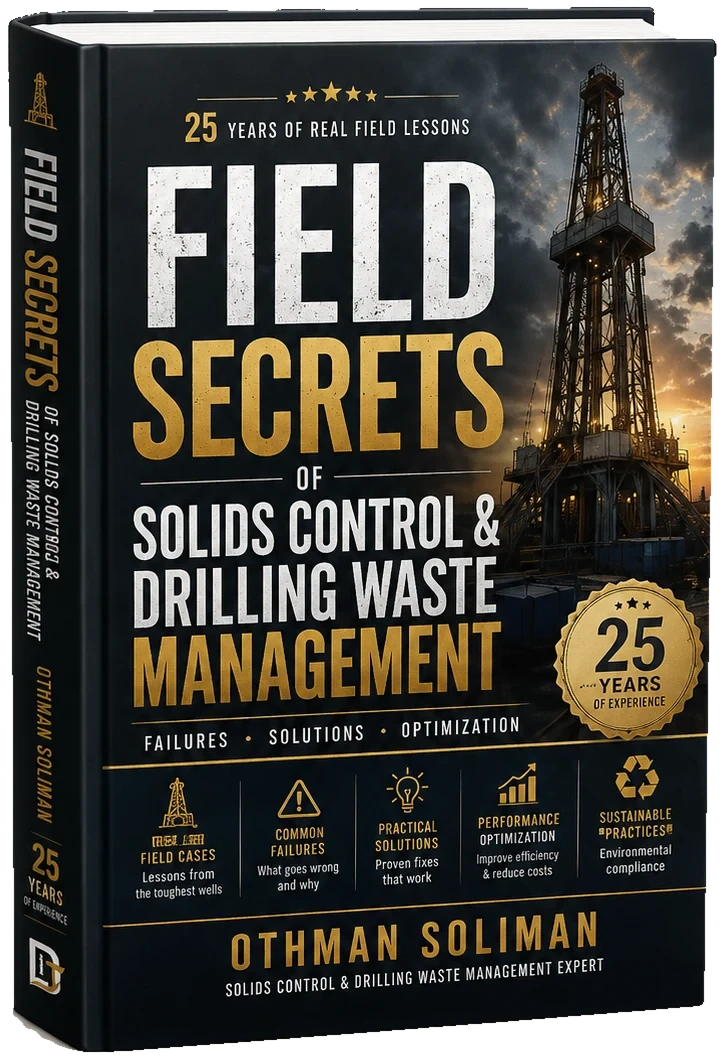
New here? Start with the book. Field Secrets — 262-page field manual, 54 chapters. Get the book →
Is your waste system recovering value — or just moving the problem?
Between the transfer chain, the cuttings dryer, the dewatering centrifuge and the disposal route, a waste system has many places to quietly lose fluid or breach a limit. An independent evaluation follows the cuttings from the shaker discharge to the skip and measures what matters — recovery and OOC.
The 10 Solids-Control Numbers Every Engineer Must Track — what to measure, the formula, the field target and the red flag. Grounded in API RP 13B-1, RP 13C, EPA 40 CFR 435 & OSPAR.
Enter your email to access the guide. We will not add you to a mailing list. Privacy policy.