Stop guessing at 3 a.m.
- 9 parts · 45 chapters, symptom to fix
- Onshore & offshore GCC / MENA
- Real cases, real numbers
Independent solids-control engineering built on API RP 13C. Field-tested tool kits, remote rig evaluations and technical advisory — turning the dirtiest part of drilling into your clearest line of savings.
Dilution is the quietest line item on the well. Put your own numbers in — see what an under-performing solids-control train may be costing you before you read another word.
A remote evaluation typically targets recovering 20–40% of this — roughly $0 back per section.
Indicative only. Loss = dilution bbl/day × built mud cost. Disposal, transport and NPT add to the real figure. Sources: AAPG Wiki; SPE-grounded solids-control handbooks; Derrick field trials (≈520 bbl saved/section).
An engineering reference and advisory built by a field engineer — not a service-company sales desk. Every recommendation traces to a published standard.
Solids control & drilling-waste across the GCC and MENA — Halliburton, MI-SWACO and NOV rigs, and operator-side drilling operations.
Feed head, G-force, cut points and screen selection checked against target bands — not opinion, not guesswork.
Vendor-neutral advisory. The recommendation serves your barrel count, not a rental fleet utilisation target.
You send the shift data and tests we ask for — stage by stage, with photos where you can. The diagnosis comes back as a written report.
The whole surface story — building the mud, cleaning it, and managing what leaves the rig — treated as one system.
Every report ends in priority actions, quick wins and an estimated-savings figure you can take to the table.
Two ways to get it done. Remote is the flagship — you send the data you already record every shift and get back a standards-based diagnosis, no mobilisation, no day rate. An on-site visit is the most thorough: we physically measure what data alone can’t show.
Daily drilling & mud reports, retort & PSD, equipment settings (shaker screens, cone count, centrifuge RPM/duty), and rig data. Whatever you have.
Shakers, hydrocyclones, mud cleaner, degasser and centrifuge — plus the mud system and waste stream — checked stage by stage against API RP 13C.
Findings, priority actions, quick wins and an estimated-savings figure — a document you can act on this section and defend to your operator.
Don’t worry about gathering it all at once. We send you this exact list and walk you through any test you haven’t run — tap each unit to see what it needs. The more you send, the sharper the diagnosis; partial data still gets a useful read.
Most of this you already record every shift. Photos of the shaker deck, cone apexes and centrifuge discharge are worth a hundred numbers — send them where you can.
When the scope includes a rig visit, we measure what shift data can never fully reveal:
Remote tells you where the fluid is going. An on-site visit tells you exactly why — down to the G-force on each deck.
Pick the piece of kit that's misbehaving. The Field Doctor walks you from symptom to the most-likely causes — ranked — and the first thing to check, the way a solids engineer would think it through on the deck.
The open reference base behind every recommendation — free for any engineer to use.
Symptom → cause → corrective action, by equipment.
Open →Shakers, cones, mud cleaners & centrifuges, with animated diagrams.
Explore →D10/D50/D90, PSD vs retort, dilution & centrifuge performance.
Learn →Mud types, PV/YP, retort & ECD — the solids-control scorecard.
Learn →What each failure looks like — engineering cross-sections, not stock photos.
View →Diagnosis, LCM, and the link to drilling fluids & solids control.
Open →Feed head, G-force, line velocity & screen checks — free, in-browser.
Run →Practical, standards-grounded writing from the shaker deck.
Read →Formulas, target bands and the method behind each call.
Browse →Solids-control, drilling-fluid & waste terms, defined plainly.
Look up →Three to start with. The full library has the rest.
How the LGS trend moves equivalent circulating density — and the drilling window.
Read →The solids-control conditions that put the drillstring at risk — and the cheap insurance.
Read →What to inspect on the train — and what a missed item costs over a section.

Read →A real failure mode, told the way it actually unfolds on the rig — one ignored symptom at a time. This is what a remote evaluation is built to catch.
12¼″ intermediate, 12.5 ppg WBM, LGS in band. Shakers carrying the load, cones cutting, centrifuge on barite-recovery duty. On paper, a healthy train.
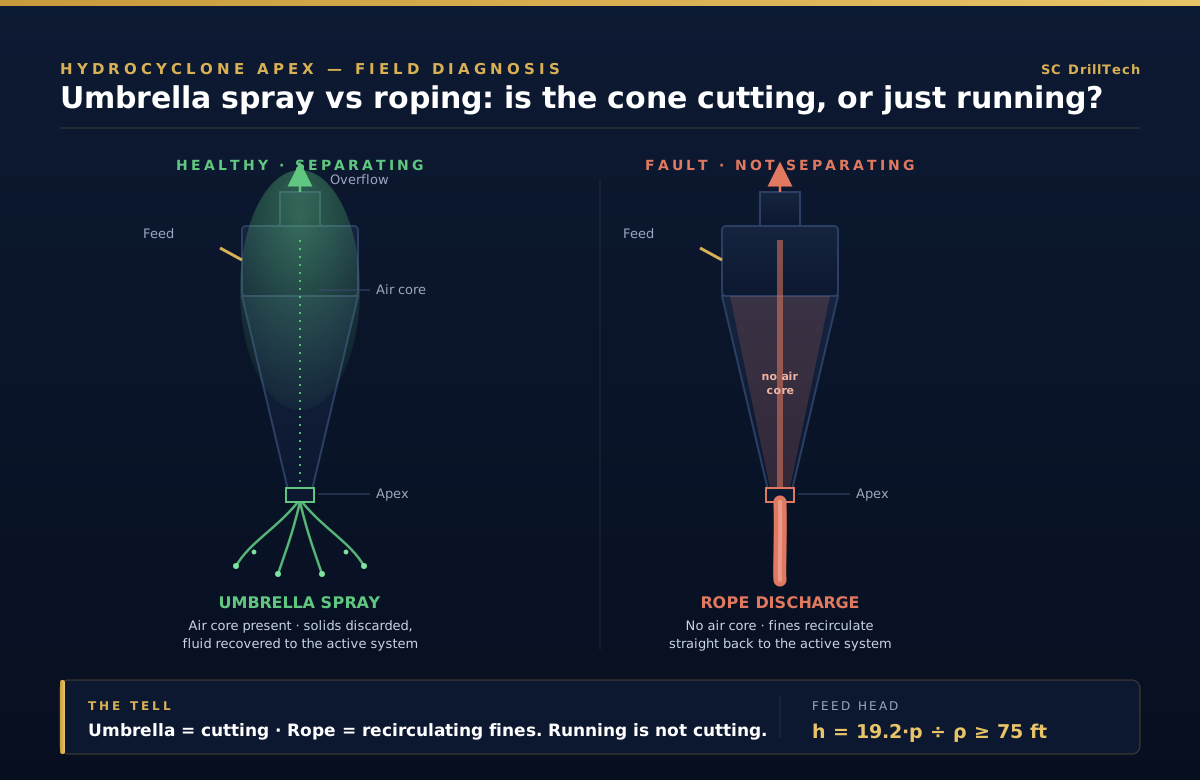
Manifold pressure slips from 38 to 26 psi over two shifts. Feed head drops below the ~75 ft the cones need to cut. The apex spray narrows from umbrella to rope.
Running is not cutting. A worn feed-pump impeller had quietly killed the head. Nobody calculated it — and a roping apex was read as "normal" instead of overloaded. Fine solids returned to the active system, shift after shift.
With the cones bypassed in effect, drilled solids built up. PV and YP rose, ROP softened, and the only lever left was the most expensive one — dilution. Barrels of new mud went in just to hold properties.
Extra dilution, lost mud and disposal across one production section — traced to a $900 impeller and a number nobody ran.
Replace the impeller, restore feed head above 75 ft, confirm the apex returns to a healthy umbrella. Re-balance centrifuge duty. The train went back to cutting within a shift.
Feed head is a two-minute calculation. The fault that costs $48k a section is almost always cheap to fix — once someone measures instead of assumes. That's the entire job.
Twenty-six years of method, built into tools you can run yourself — the same checks behind the free reference. Launch pricing for the first 200 engineers.
Start with a remote evaluation — we'll show you where the barrels are going, and exactly how to capture them back.
A symptom-indexed field reference for the solids-control train — each entry built like a field manual: severity, immediate risk, ranked causes, how to diagnose, corrective actions and a verification test.
Two questions. The most-likely causes come back ranked by probability — weighted from field experience, not a flat list — with the first thing to check right now.
Open any guide for the full field write-up and a live cost-of-fault estimate.
More guides are added continuously across shaker, hydrocyclone, centrifuge, mud system, degasser and waste-management failure modes.
Send your shift data and let the diagnosis come back as a written report — the whole train, against API RP 13C.
Request an evaluation →Particle size distribution is the one idea that ties the whole removal train together — what size your solids are, which machine owns each band, and why the curve, not the retort alone, tells you where your dilution is going.
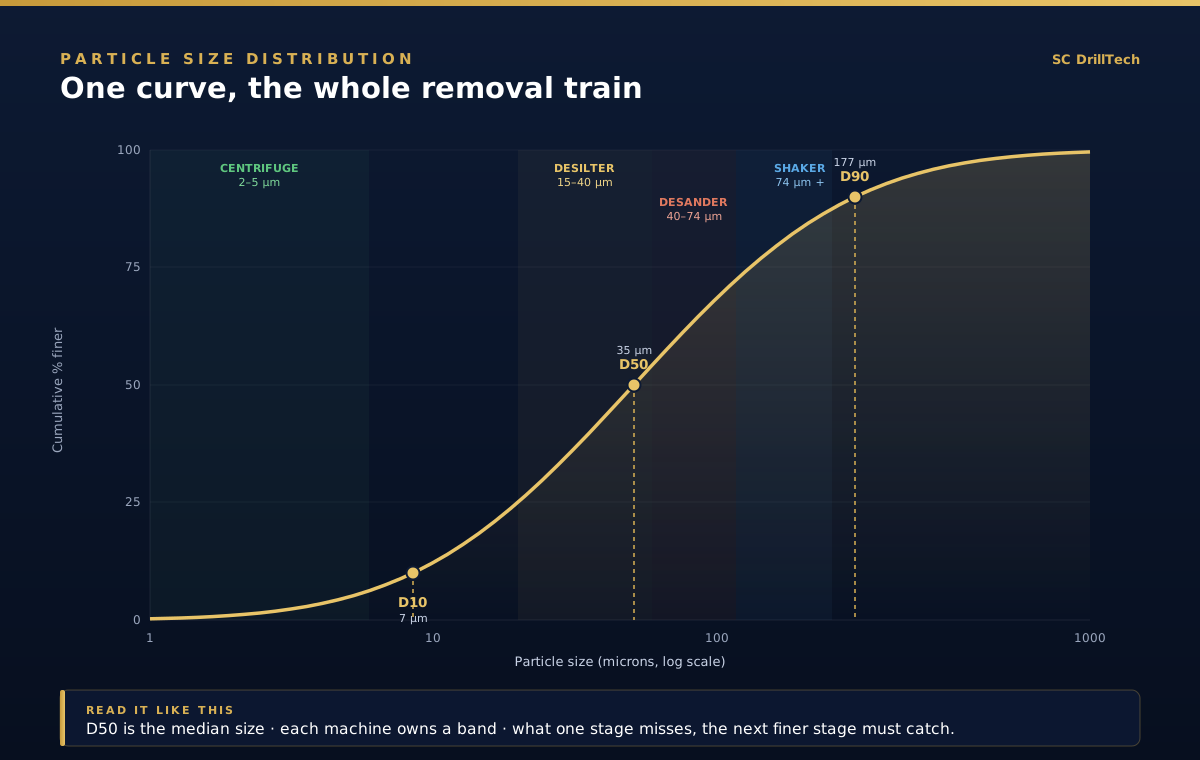
Particle size distribution (PSD) is the full picture of what sizes of solids your mud is actually carrying — not one number, but the whole spread, from colloidal clay below 2 µm to coarse cuttings above 100 µm. Every screen cut, every cone, every centrifuge setting is a statement about where on this curve you are trying to cut. Read the PSD and the whole removal train stops being a row of machines and becomes one coherent system: each stage owns a size band, and what one stage misses, the next finer stage must catch — or dilution pays for it.
PSD is read at percentile points — the size below which a given fraction of the solids lies:
| Value | Means | Tells you |
|---|---|---|
| D10 | 10% finer | The fine tail — colloidal / reactive load the centrifuge fights. |
| D50 | 50% finer (median) | The middle of the distribution — the single most-quoted size. |
| D90 | 90% finer | The coarse end — what the shaker and desander should be catching. |
| D100 | 100% finer | The largest particle present — the screen cut point (API RP 13C). |
A useful habit: a tight distribution (D10 and D90 close together) is easy to cut cleanly; a wide one (fines and coarse together) means no single stage can do the job — you need the whole train.
PSD and the retort measure different things — they are complementary, not rivals. The retort (API RP 13B-1/13B-2) tells you how much solid is in the mud by volume (oil / water / total solids), and with mud weight you split that into barite and low-gravity solids. PSD tells you what size those solids are. One is quantity; the other is size.
You need both. The retort says “you have 18% solids and your LGS is climbing”; the PSD says “and they are fine — D50 has dropped to 20 µm, so the shaker can’t touch them; this is a centrifuge job.” Together they tell you not just that you have a solids problem, but which machine owns it.
Dilution is the most expensive lever on the rig, and PSD tells you when you are being forced to pull it. As the distribution shifts finer — D50 falling, the fine tail growing — mechanical removal gets harder: the solids are now below the cut point of every stage except the centrifuge. If the centrifuge can’t keep up, the only fast lever left is dilution, and the curve is telling you why your dilution rate is climbing.
The lesson: catch solids coarse and early, before they grind finer on every circulation and migrate down the curve into the colloidal range that only dilution and the centrifuge can chase. A rising fine tail is a dilution bill forming.
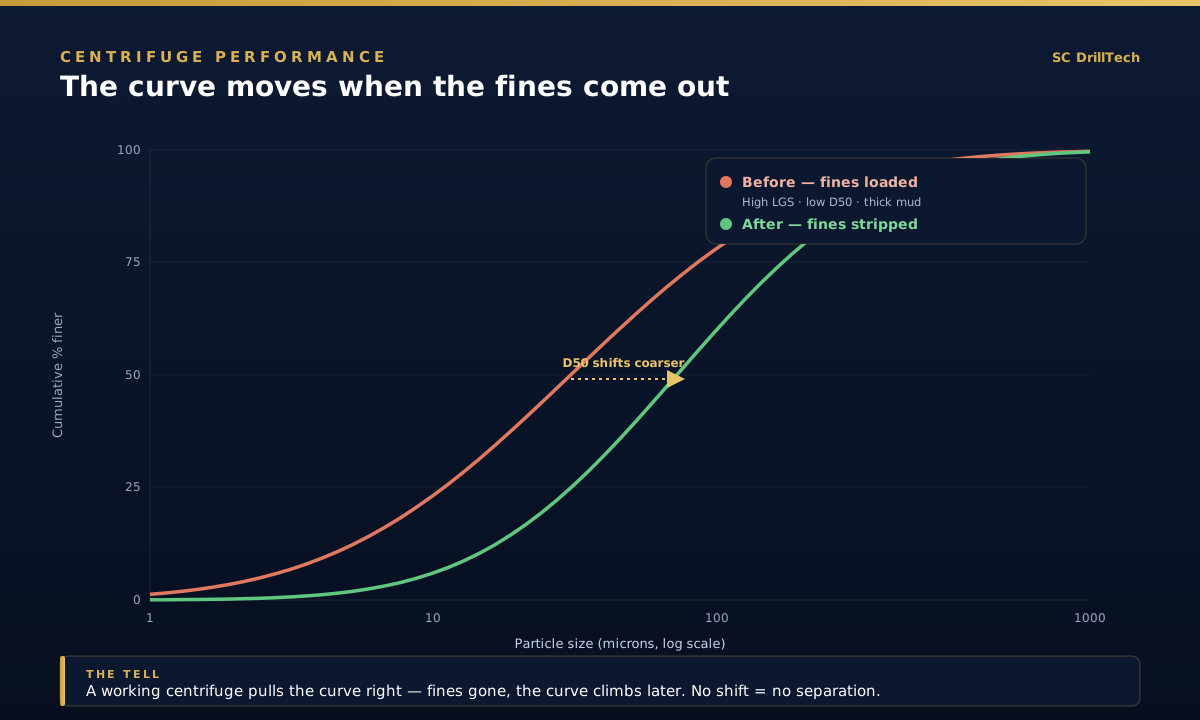
The centrifuge is the only stage that reaches the fine end of the curve — and PSD is how you prove it is working. A centrifuge that is genuinely cutting shifts the whole distribution coarser: it strips the fines, so the curve moves right and climbs later. No shift means no separation — the machine is running but not cutting (often poor recovery or wrong duty).
Compare a feed-vs-effluent PSD across the bowl and you have a direct, defensible measure of the cut point — see the decanting centrifuge guide for the duty settings that move it.
Low-gravity solids (LGS) and the fine end of the PSD are the same enemy seen two ways. The fines that build at the D10 end are the drilled solids the equipment failed to catch while they were coarse — ground finer on every circulation until they disperse into colloidal clay (rising MBT) that no screen or cone can touch.
This is why PSD is a leading indicator: the fine tail starts growing before plastic viscosity and dilution confirm the problem. Watch the bottom of the curve and you catch the fines while the centrifuge can still take them — wait for the retort and you are already diluting.
Reading a PSD in the field comes down to a few questions:
Match the symptom to the stage: coarse survivors → shaker / desander; mid-range building → cones at low head; fine tail growing → centrifuge duty or hours.
Case — the dilution that PSD explained. A mud thickening with dilution climbing, retort solids “only” at 17%. The PSD showed D50 had fallen from 45 to 22 µm over the section with a fat fine tail — the solids were now below every cut except the centrifuge, which was running six hours a day. The fix was not chemistry: it was centrifuge hours, not dilution.
Case — the coarse survivors. Sand content low, yet abrasion wear high. The PSD’s coarse end (D90) sat well above the shaker cut — a holed panel was passing coarse solids the sand test, sampled elsewhere, never saw. The curve found what a single number hid.
Cases are illustrative of the method, not specific wells.
Send your particle-size and retort data — SC DrillTech will map it against each stage’s cut band and tell you which machine owns your fines.
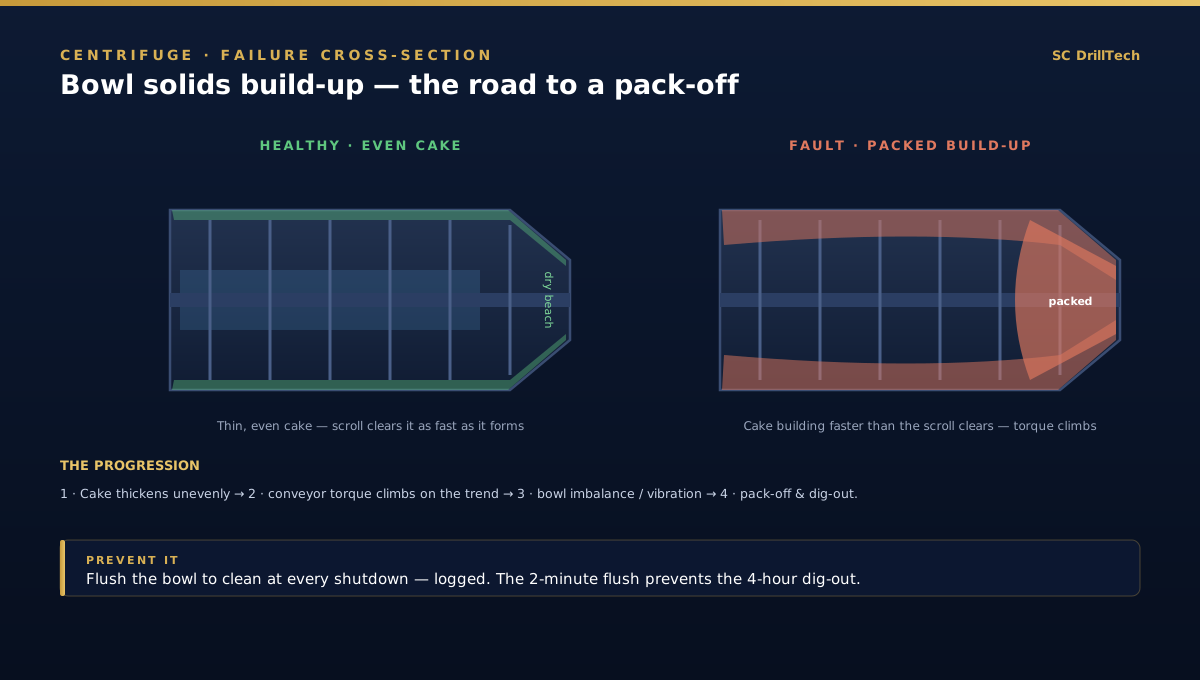
What each failure actually looks like — drawn as engineering cross-sections, not stock photos. Every entry pairs the visual tell with its root cause, its cost, and a direct link to the full troubleshooting guide.
Torque baseline creeping up shift over shift; vibration after restart.
Cake accumulating faster than the scroll clears it — usually a missed flush at shutdown.
The precursor to every pack-off, torque trip and dig-out.
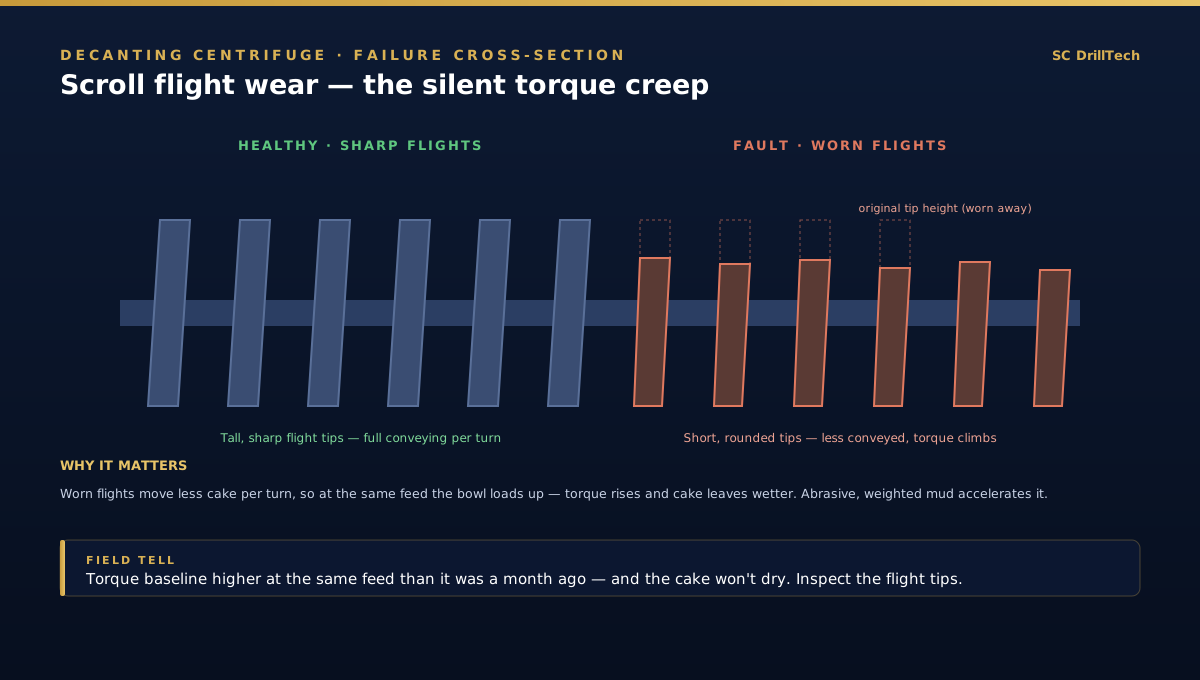
Higher torque at the same feed than a month ago; cake won't dry.
Abrasive solids erode the flight tips, so each turn conveys less cake.
Rising torque and wet discard — lost recovery and run-time.
Constant high vibration on a clean, empty bowl; heat/noise at a housing.
Lubrication failure or wear on a heavily loaded high-speed bearing.
Catastrophic failure in minutes if run through — a lock-out.
Sloppy, smearing cake instead of dry, crumbling discharge.
Pond too deep, feed too fast, or G below the dewatering duty.
Recoverable fluid leaving with the discard — dilution climbs.
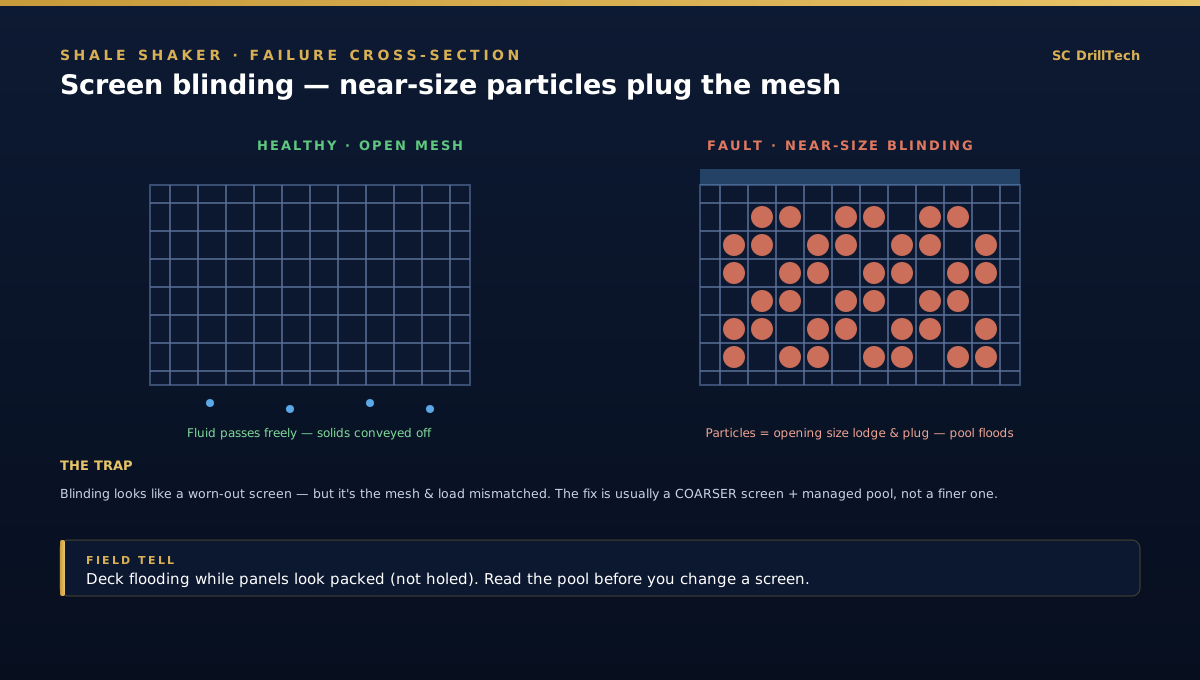
Deck flooding while panels look packed (not holed).
Near-size particles lodge in the openings and plug the mesh.
Fine solids bypass the cheapest removal stage — dilution rises.
LGS / sand rising while the shaker looks normal.
Improper tensioning, worn deck rubbers, or shock loading tears the cloth.
Quiet bypass of unscreened solids — loads the whole train.
Fluid carried over the discharge end; no defined beach.
Screen too fine for the load, mismanaged pool, or uneven feed.
Whole mud lost over the end — direct fluid loss + waste.
LGS climbing with the shaker apparently fine.
A path around the mesh — failed gasket, holed panel, or open bypass gate.
Unscreened solids enter the active system invisibly.
Apex discharging a solid rope, no air core; manifold pressure low.
Low feed head — usually a worn feed-pump impeller — or an overloaded apex.
Fines recirculate for a whole section — the cone isn't cutting.
A dry, silent apex — no discharge from one or more cones.
Apex too small, or trash / LCM with no protective screen upstream.
Dead cones send their fines straight back to the mud.
Thin, watery apex discharge carrying little solids.
Worn-open apex under-classifies, or marginal feed head.
Cones spray but remove little — LGS creeps up.
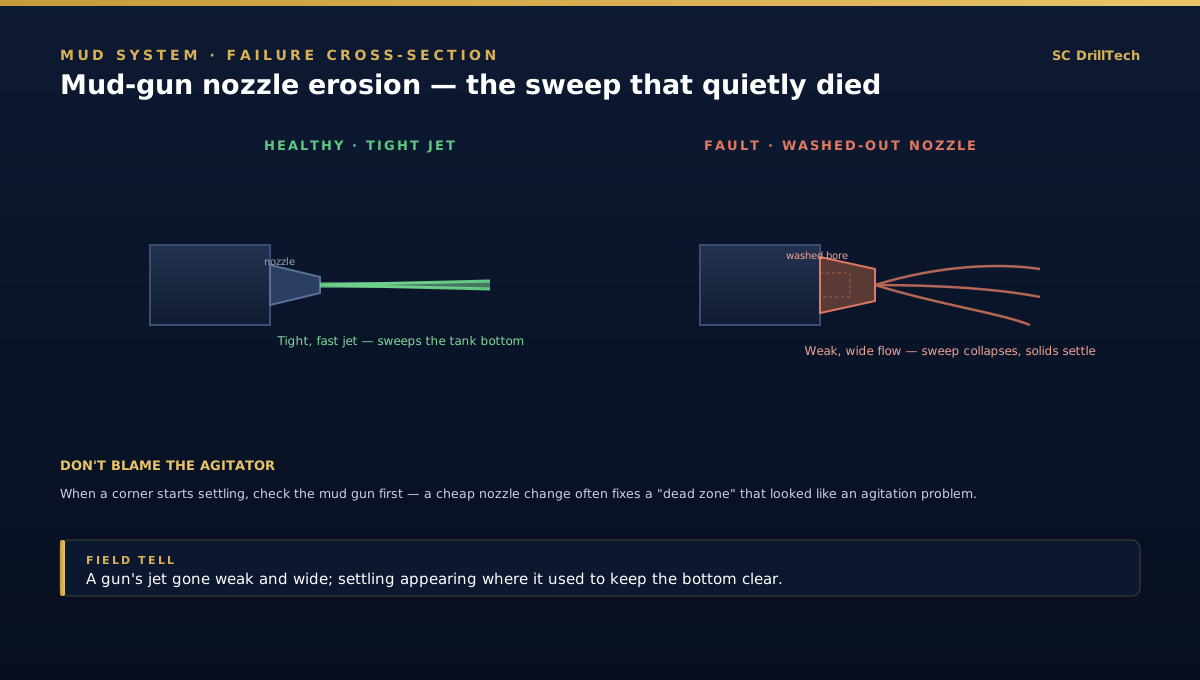
A gun's jet gone weak and wide; settling where it used to sweep.
Abrasive solids at high velocity wash out the nozzle bore.
Lost agitation — dead zones form and solids settle.
Settling despite the agitator running; weak surface pattern.
Abrasive wear thins the impeller blades, so they move less mud.
Failing suspension — barite-sag risk on weighted mud.
Solids bed in corners; properties differ before / after stirring.
Agitator / gun coverage leaving corners unswept.
Lost active volume; solids re-suspend as a slug.
These are engineering illustrations of real failure modes — accurate to the mechanism, owned by SC DrillTech, and consistent across the library. Seeing a failure on your rig? Request an evaluation.
The properties that keep a well drilling — and how almost every one of them is really a solids-control scorecard. The fundamentals a mud or solids-control engineer reads every shift, framed toward where SC DrillTech lives.
Drilling fluid is the most multi-tasked material on the rig. Before anything else, it has to do several jobs at once:
Every property you measure is really a check on one of these jobs — and almost all of them are degraded by the same thing: drilled solids the system fails to remove. That is the thread that ties drilling fluids to solids control.
Mud systems fall into three broad families, chosen for the formation, the environment and the cost of disposal:
| System | Base | Where it fits |
|---|---|---|
| Water-based (WBM) | Fresh / brine water | Most common, lowest disposal cost, widest chemistry |
| Oil-based (OBM) | Diesel / mineral oil | Shale stability, high temperature, lubricity |
| Synthetic / NAF (SBM) | Synthetic base fluid | OBM performance with a better environmental profile |
On non-aqueous fluids (OBM/SBM) the base fluid is expensive and the discharge is regulated, so every barrel lost on the cuttings is both a cost and a compliance issue — which is why the cuttings dryer and tight solids control matter most there.
A handful of properties tell you almost everything about the fluid’s health. These are the numbers on every daily mud report:
| Property | What it measures | Watch for |
|---|---|---|
| Mud weight | Density / hydrostatic control | Sag, gas-cut, barite balance |
| PV (plastic viscosity) | Mechanical friction — mostly solids | Rising = fine-solids load building |
| YP (yield point) | Carrying capacity / gel structure | Too low = poor hole cleaning |
| Gels (10s/10m) | Suspension at rest | Flat = sag risk; high = ECD spikes |
| Retort (oil/water/solids) | Solids & liquid volumes | Total solids, LGS vs barite split |
| MBT | Reactive clay (CEC) | Rising = colloidal drilled solids |
| Sand content | Coarse abrasives > 74 µm | Equipment wear, shaker bypass |
| API fluid loss | Filter-cake quality | High = thick cake, differential sticking |
Notice how many of these point straight back at solids — PV, retort, MBT and sand are, in effect, solids-control scorecards in disguise. See the PSD Knowledge Center for the size dimension behind them.
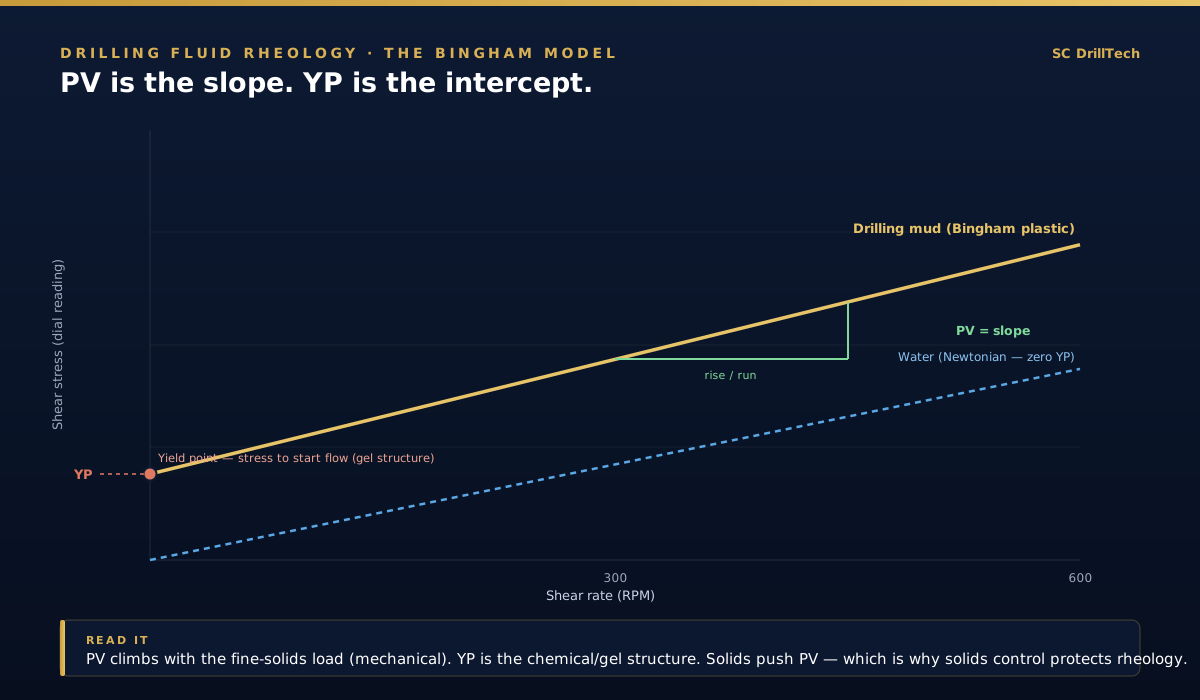
Drilling mud is a Bingham plastic: unlike water, it needs a minimum stress just to start moving. Plot shear stress against shear rate and two numbers fall out — the slope and the intercept.
This is the cleanest way to see why solids control is rheology control: you manage YP with chemistry, but you only manage PV by removing solids. See PV & YP explained.
Two solids share the mud and behave like opposites:
| Barite (weight material) | Low-gravity solids (LGS) | |
|---|---|---|
| Specific gravity | ~4.2 | ~2.6 |
| You want it | Yes — you paid for density | No — drilled waste |
| Effect on PV/ECD | Controlled | Drives both up as it grinds finer |
The whole art of solids control is to remove the LGS while keeping the barite — which is exactly why a mud cleaner exists, and why a centrifuge has two opposite duties. Get this split wrong and you either discard weight material or let fine LGS strangle the rheology. See LGS & the retort and barite & sag.
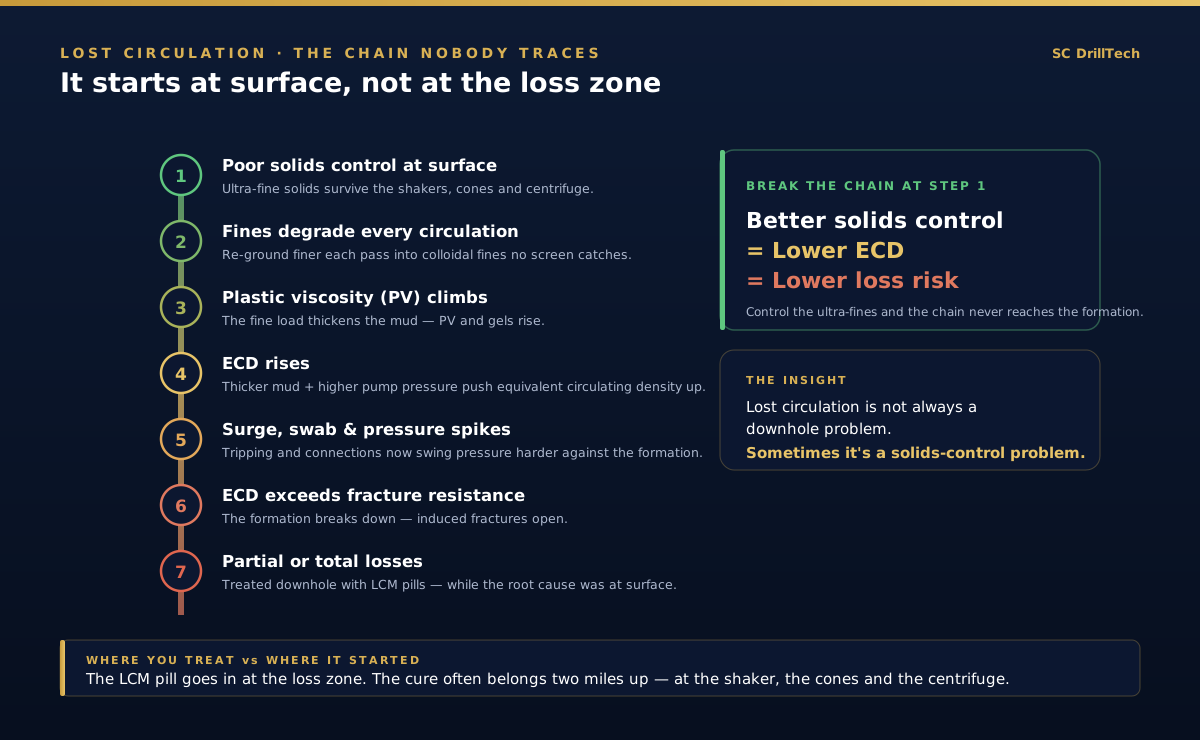
Mud weight is the hydrostatic barrier, but the formation feels ECD — equivalent circulating density — which is mud weight plus the friction of pumping it. The fine-solids load raises ECD through PV, which is the bridge to lost circulation.
Barite sag is the other side: if suspension fails (flat gels, low-side wells), heavy barite settles, and you get alternating light and heavy mud — a well-control hazard. Sag is a suspension problem, and suspension is a properties problem kept healthy by the right solids balance. See ECD & solids load and the Lost Circulation Center for where rising ECD ends.
The daily check is standardised so any engineer reads the same number the same way (API RP 13B-1 for water-based, 13B-2 for non-aqueous):
These tests are also exactly what a remote evaluation reads — the mud report is the window into how well the solids-control train is doing its job.
Drilling-fluid properties are the scoreboard; solids control is how you keep the score. PV, retort, MBT and sand all move with the drilled-solids load — so a clean removal train is what keeps the mud in spec, the ECD down and the dilution bill small. Fundamentals here, mechanics in the equipment guides, size in PSD, consequences in Lost Circulation.
Send your daily mud and retort data — SC DrillTech will tell you what your PV, MBT and sand are really saying about the removal train.
Practical guidance on diagnosing mud losses, selecting LCM, and understanding the relationship between lost circulation, drilling fluids, and solids-control systems.
Lost circulation is not only a drilling problem. Poor solids-control decisions can increase mud losses, waste valuable LCM, and significantly raise well costs. This center looks at losses from the angle SC DrillTech knows best — the surface system.
Lost circulation is the loss of whole drilling fluid from the wellbore into the formation — fluid leaving through fractures, vugs or permeable rock, not filtering through a cake. It is measured by what the pits lose, in barrels per hour.
Losses vs fluid loss — don’t confuse them. Fluid loss (API filtrate) is the small, controlled seepage of liquid through the filter cake, measured in mL. Lost circulation is whole mud — solids and all — disappearing into the formation. One is a cake-quality number; the other is a returns problem.
Operational impact: lost hydrostatic head (well-control risk), lost expensive fluid, non-productive time, and in severe cases an inability to keep the hole full. It is one of the costliest events on a well.
Losses are graded by rate, because the rate decides the response:
| Type | Typical rate | Symptom & impact |
|---|---|---|
| Seepage | < ~10 bbl/hr | Slow pit drop; often permeability or near-balance — manage with fine LCM/sweeps. |
| Partial | ~10–50 bbl/hr | Clear, steady pit loss with returns still at surface — LCM pills, monitor ECD. |
| Severe | > ~50 bbl/hr | Heavy loss, reduced returns — coarse LCM, pills, slow the pumps. |
| Total | No returns | No fluid back at surface — hole may not stay full; well-control priority. |
The grade is the first thing a field diagnosis establishes — it sets both the urgency and the LCM strategy.
Where the fluid goes tells you what you are fighting:
Note the pattern: two of these — induced fractures and weak formations — are pressure-driven, and pressure is driven by ECD, which is driven by the fine-solids load. That is the SC DrillTech angle.
You rarely see the loss zone — you read it from surface signs. Four signals, read together, grade the loss:
| Signal | What it shows |
|---|---|
| Pit volume trend | The primary measure — rate and shape of the active-pit drop = the loss rate. |
| Flow show (flowline) | Returns reduced vs none = partial vs total; the flow-out paddle confirms. |
| Standpipe pressure | A drop can signal losses (and U-tube); rising ECD before a loss is the warning. |
| Mud properties | Climbing PV/ECD ahead of an event points to a fine-solids cause, not just the formation. |
Read all four. A pit drop with full flowline returns and a falling SPP reads differently from a total loss with no returns — and the mud trend tells you whether you helped cause it at surface.
This is where SC DrillTech has something few others say. The solids-control system can either protect you from losses — or quietly make them worse and waste the LCM you’re paying for.
The shaker is where LCM is won or lost. Run normal screens during an LCM treatment and the deck screens out the very material you just pumped — throwing expensive fibres and flakes straight to waste. The fix is deliberate screen selection: coarsen the deck, or bypass the shaker for the LCM circulation so the material survives to the active system. See the shaker guide and screen blinding.
The mud cleaner’s fine screen will also reject coarse LCM. During treatment, know when to bypass the cones / cleaner so the LCM isn’t classified out — then return to normal once the pill is placed. It’s an operational decision, not a set-and-forget. See the mud cleaner guide.
A centrifuge running through an LCM treatment can strip out the sized material you need in suspension, and load itself with fibrous solids it was never meant to handle. The recommendation: idle or isolate the centrifuge during active LCM work, and resume once the treatment has done its job. See the centrifuge guide.
Beyond protecting the pill, the bigger prize is not generating the problem: controlling ultra-fine drilled solids keeps PV and ECD down so you induce fewer losses in the first place. Better solids control upstream means fewer LCM events downstream.
LCM is grouped by particle shape, because shape decides how it bridges and seals. An overview — sizing and selection are an expanding topic here:
| Category | Purpose | Typical application |
|---|---|---|
| Fibrous | Span and mat across openings | Seepage to partial; builds a base for other LCM |
| Flaky | Lay over and cover the face | Permeable zones and fractures; surface sealing |
| Granular | Bridge and plug at the throat | Wider fractures; the structural bridging particle |
Effective pills often blend all three — granular to bridge, fibrous to span, flaky to seal. Detailed selection and sizing are flagged below as coming soon.
Losses are expensive on more than the fluid line. A single event compounds across the cost sheet:
Simple example: a partial loss of 30 bbl/hr on an OBM at a fully-loaded cost of a few hundred dollars a barrel runs into five figures a day before a single hour of NPT — which is why prevention at surface (controlling ECD via solids) pays for the whole solids-control effort many times over.
Version 1 establishes the topic from the solids-control and drilling-fluids angle. Planned next:
Before the next LCM pill, let SC DrillTech check whether your fines load is feeding the problem — a remote review of your PV/ECD trend, PSD and solids-control performance.
From the bit, through the separation train, and back to the well — or out as compliant waste. The system SC DrillTech measures and optimises, station by station.
Mud is pumped down to cool the bit and carry rock to surface, then returns up the flowline carrying everything the bit just cut. The clean-up starts here.
The loop beginsThe first and most important line of defence. Vibrating screens — labelled by API RP 13C — pull the coarse drilled solids out before anything downstream sees them.
Coarse separationDesanders and desilters spin the fluid so finer solids are thrown to the wall and drop out — but only when the feed head is right, around 75 ft.
≈ 75 ft feed headRemoves what nothing upstream could. Set the other way, the same machine recovers expensive barite instead of throwing it away — the most flexible tool on the train.
Set to duty · G-forceEvery solid removed here is a barrel of dilution you didn't have to build. The recovered fluid rejoins the active system and heads back down the hole.
η ↑ · dilution ↓What can't be reused is dried, dewatered and routed to disposal — re-injection, solidification or closed-loop — with the documentation to prove compliance.
DWM · compliantEvery station is a number — and a chance to recover fluid, cut dilution and dry the waste. Run those numbers yourself, or send us the data.
Three field-built tool kits that turn raw rig readings into senior-engineer decisions — diagnose the solids-control train, put a dollar figure on the fluid you're losing, and walk into the morning meeting with numbers, not opinions. Instant download, lifetime updates, five languages. Runs in Excel & Google Sheets.

of Solids Control & Drilling Waste Management — 26+ years of real rig lessons.
Good solids control is invisible. Bad ones cost you everywhere — this is the playbook for staying on the invisible side.
The hard-won field manual from the rig floor — the failures, the fixes and the optimisation the textbooks leave out. 262 pages · 54 chapters · grounded in API RP 13C.
"Run a senior mud engineer's checklist on every single shift."
You type in your shaker, cyclone and centrifuge readings. In seconds it tells you which stage is dragging the whole train down, by how much, and what it's costing you — so you stop guessing whether the problem is the screens, the feed head, or the pump. It's the experience of a 25-year hand, sitting inside one toolkit.
"Turn a wet and a dry cuttings weight into a barrels-lost number you can defend."
Enter the wet and dry weights of a cuttings sample and it back-calculates exactly how much fluid is leaving the rig on the cuttings — then logs every sample and checks each one against your discharge limit. When someone asks "how do you know we're losing that much?", you have the method, the math, and the paper trail.
"The whole fluids programme in one workbook — measured, not guessed."
Twenty-eight field calculators covering mud, solids control, hydraulics, cement, chemistry and cost — type into the gold cells, read the navy results. Every sheet prints its own formula, so there is nothing to take on trust and nothing to install.
"Run the rig audit a service company charges for — yourself."
A complete, field-built kit for auditing a surface mud & solids-control system end to end: a fully worked report you type over, an Excel workbook that does every calculation, and a guide that ties them together. Editable Word + Excel, no macros.
A ready-to-teach, two-part operator course — 111 slides across 12 modules: drilling fundamentals, fluids, mud properties, solids control, and the full drilling-waste-management workflow. Editable PowerPoint — train your crew or study solo.
You send the data; we return standards-based engineering you can act on — evaluations, surveys and drawings, costed savings plans, equipment-specific training and custom technical reports. No travel, no downtime, no guesswork.
Send daily reports, retort data and equipment specs. We return a full solids-control evaluation: removal efficiency, equipment-level diagnosis, target bands, and a prioritised list of fixes — each with its dollar value.
Professional survey reports for mud plants, solids-control packages and rig-site layouts — complete with engineering drawings. Just send photos, dimensions and the measurements of your equipment or tanks, and we return a clean, scaled, professionally drafted survey your team and clients can rely on.
A costed optimization plan for your solids-control and drilling-waste-management operations. Send us your parameters and the equipment in use; we build a baseline cost model, find where money is leaking, and hand back a prioritised savings plan with the dollar value behind every move.
Don't worry about gathering it all up front — we guide you through an intake checklist:
Operator and engineer training built around your exact equipment — solids control or drilling-waste management. Not a generic slide pack: a complete program that lets you prove competency, not just attendance.
Need a specific technical report? We scope and produce it — equipment selection studies, screen and cone sizing, centrifuge duty analysis, dilution and discharge studies, waste-management and compliance documentation, and more. Tell us what you need and the decision it has to support, and we deliver a clear, defensible, standards-based document.
Remote troubleshooting on call: equipment selection, screen and cone sizing, centrifuge duty, dilution-cost reduction, and a review of your solids-control program before the next section.
Open-access formulas, cheat-sheets and a field FAQ — so your team can read the method behind the result, not just the recommendation.
Reports, measurements, photos or parameters — whatever the job needs. A short intake form or checklist keeps it simple.
Every value is checked against API RP 13C target bands using the same engine inside our tool kits — then drafted, costed or written up.
A clear, professional document — report, drawing set, savings plan or training package — ready to act on or present.
A short call to walk your crew through it and answer questions before the next section.
A detailed list covering drilling parameters, the drilling fluid, and every unit in the circuit — flow line, header box, shakers, vacuum degasser, hydrocyclones, centrifuge, mud system, agitators, mud guns, mixing system and DWM equipment. We also help you run the required tests.
You return the completed data, test results and photos. We review it and run the engineering — a full mass balance and equipment review per API RP 13C, each unit and the whole circuit, to find where fluid and money are leaving.
Observations, root causes and prioritised recommendations to raise system efficiency — with supporting drawings, a system layout and improvement proposals, ranked by payback and ready for the morning meeting.
An honest word, engineer to engineer: a remote evaluation and an on-site evaluation are not the same thing. A remote read is only as deep as the data and tests you run for us — so choose by the depth your problem actually needs.
We send the requirements list and guide you through the checks, step by step, across the full circuit. You send back the data, tests and photos; we run the engineering and return the report — no travel, no downtime.
Limit: it reflects the data and tests you run — it can't directly measure what needs instruments and hands on the equipment.
We're on the rig with the instruments and the trained eye. Everything in the remote tier, plus the measurements and live inspection a remote read simply can't reach — done in person, in real time.
An on-site evaluation will always go deeper than a remote one — that's the honest trade.
If you need speed, the remote evaluation fits and starts today. If you need the deepest analysis — a shaker vibratory system analysis, live inspection, real-time measurement — being there is better. Tell us the problem and we'll tell you honestly which one it needs.
A material-balance number is where a solids-control evaluation starts — not where it ends. Even a fully rigorous mass-and-volume balance, with all the mathematics behind it, only captures a single moment of a process that never stops moving.
Cuttings degrade, particle-size distribution shifts from run to run, formation mineralogy changes with depth, and the mud itself keeps altering how solids behave. A point-in-time snapshot can't account for any of that on its own — which is exactly why a serious evaluation reads trends over time and is completed through a direct technical discussion, not a form.
We look at how removal efficiency, dilution and discard move across runs — not one reading — so the diagnosis reflects the real, ongoing process on your rig.
Particle-size distribution drives centrifuge cut points and solids-handling efficiency; mineralogy explains what a balance alone cannot. Where it matters, these analyses complement the assessment.
The sharpest findings come from a technical conversation about your specific spread, formation and goals — supported by proprietary methods refined over 26+ years in the field.
First, we send you a detailed requirements list covering the drilling parameters, the drilling fluid, and every unit in the circuit — and we help you run the required tests. You send it back; then we build and deliver a complete report with observations, recommendations to raise system efficiency, and supporting drawings and layout.
Describe your rig, your equipment and the job in front of you. We'll reply with exactly what we'd need from you and what you'll get back.
Start a request →The next phase takes SC DrillTech from remote to on-site. Join the waitlist and you'll be first in line when these launch in your region.
A field engineer on your rig: full solids-control, drilling-fluids and waste audit with hands-on equipment inspection and live measurement.
Hands-on crew training at the shaker deck — reading equipment, setting screens, and running the system to its target bands.
On-call field support during critical sections: setup, optimisation and troubleshooting alongside your team.
Be the first to know when on-site services reach your region.
Add me to the list →The formulas, target bands and definitions behind every SC DrillTech recommendation — open for any engineer to use. No sign-up required.
The same relationships built into our tool kits and reports, per API RP 13C.
| Quantity | Formula | Target / band |
|---|---|---|
| Shaker / centrifuge G-force | G = N² · s ÷ 70,414 | Shaker 4–8 g |
| Agitator turnover (TOR) | TOR = (V ÷ Q) · 60 | 40–85 s |
| Hydrocyclone feed head | h = 19.2 · p ÷ ρ | ≥ 75 ft |
| Line velocity | v = 0.4085 · Q ÷ d² | 4–8 ft/s |
| Removal efficiency | η = 100 (1 − k), k = Vc/Ve | > 70% good |
| Equipment capture | wₐ = 100·w₃(w₁−w₂)/[w₁(w₃−w₂)] | ≥ 50% good |
Every symbol and unit used across solids control, mud and DWM — defined in plain language.
Field-friendly notes on the screen-labelling and test standard that underpins our work.
One-page references for the most-used calculations — the lite version of the tool kits.
Common solids-control and waste questions, answered from rig experience.
EPA, OSPAR & ROPME discharge limits and zero-discharge — explained for the field.
Solids control grew from open earthen pits into one of the most cost-sensitive systems on the rig. Here's how the equipment — and the thinking behind it — evolved.
Early rotary rigs simply circulated mud through large earthen settling pits. Cuttings dropped out by gravity alone — slow, imprecise, and wasteful of fluid, but the only "equipment" available.
Vibrating screens borrowed from the mining industry arrived on the rig floor. For the first time, the largest cuttings could be removed mechanically at surface instead of waiting for them to settle.
Cone-shaped hydrocyclones used centrifugal force to pull finer solids out of the fluid. Larger desanders handled sand-sized particles; smaller desilters reached the silt range — extending removal well below what a screen could catch.
Adapted from food and chemical processing, the decanting centrifuge let engineers recover valuable barite and strip ultra-fine drilled solids — opening the door to far higher removal efficiency on weighted muds.
Linear-motion shakers improved conveyance and let crews run finer screens. The mud cleaner combined a bank of desilter cones with a fine screen, salvaging weight material that cyclones alone would discard.
Advances in screen weaving and balanced-motion decks pushed cut points finer than ever. To make screens comparable across makers, the industry standardised labelling and testing — work that became API RP 13C, the backbone of modern solids-control measurement.
Tightening environmental rules turned attention to what left the rig. Cuttings dryers, dewatering units and closed-loop systems emerged to cut discharge, recover fluid and move toward zero-discharge operations.
Real-time monitoring, automation and economic modelling reframed solids control as a measurable cost centre — not a back-of-rig afterthought. The question shifted from "is it running?" to "what is it costing us, and how do we prove the savings?" That's exactly where SC DrillTech works.
The principles haven't changed — the precision has. Put a century of method to work on your next section.
See the tool kits →Solids control works as a sequence — each machine takes the particle the one before it couldn't. Coarse to fine, surface to centrifuge. Here's the full train and what each stage actually does.
Tap any machine for its full field reference: function, components, operating parameters, performance indicators, failure modes and direct links to its troubleshooting guides.
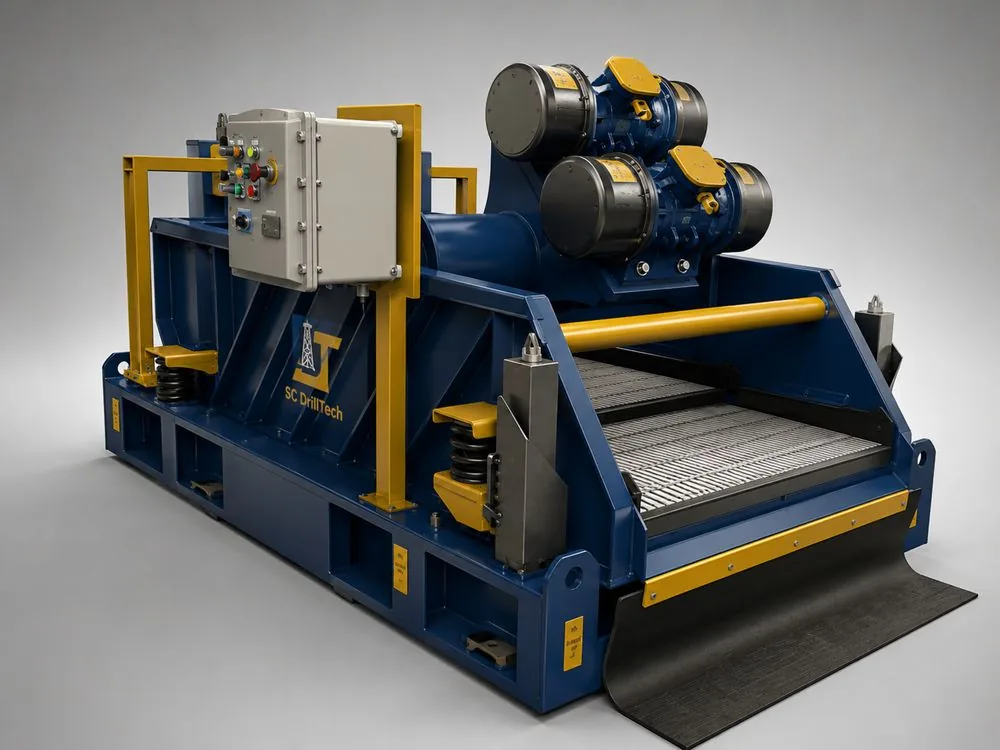
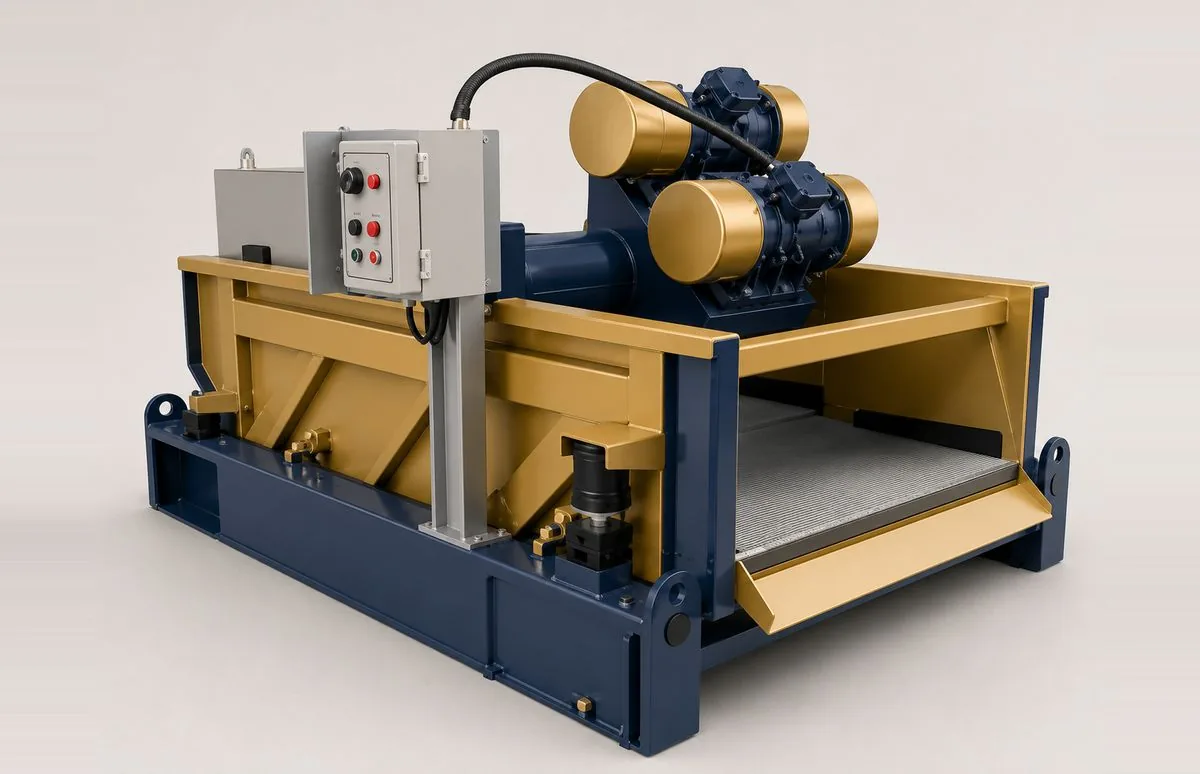
The first and most important line of defence. A vibrating screen deck throws the whole mud stream across mesh that lets fluid through and conveys cuttings off the end. Get the shaker right and every machine downstream has less to do.
Motion type (linear, balanced-elliptical), G-force and screen selection decide how fine a cut you take before the fluid carries on.
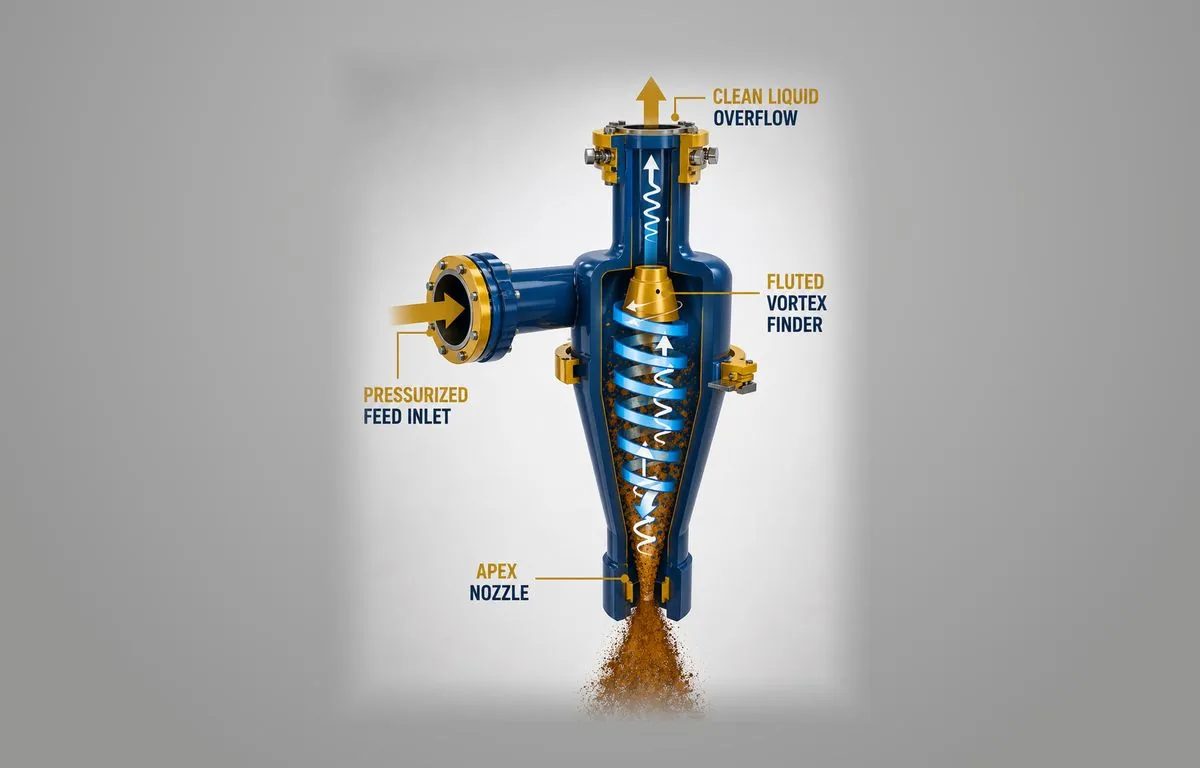
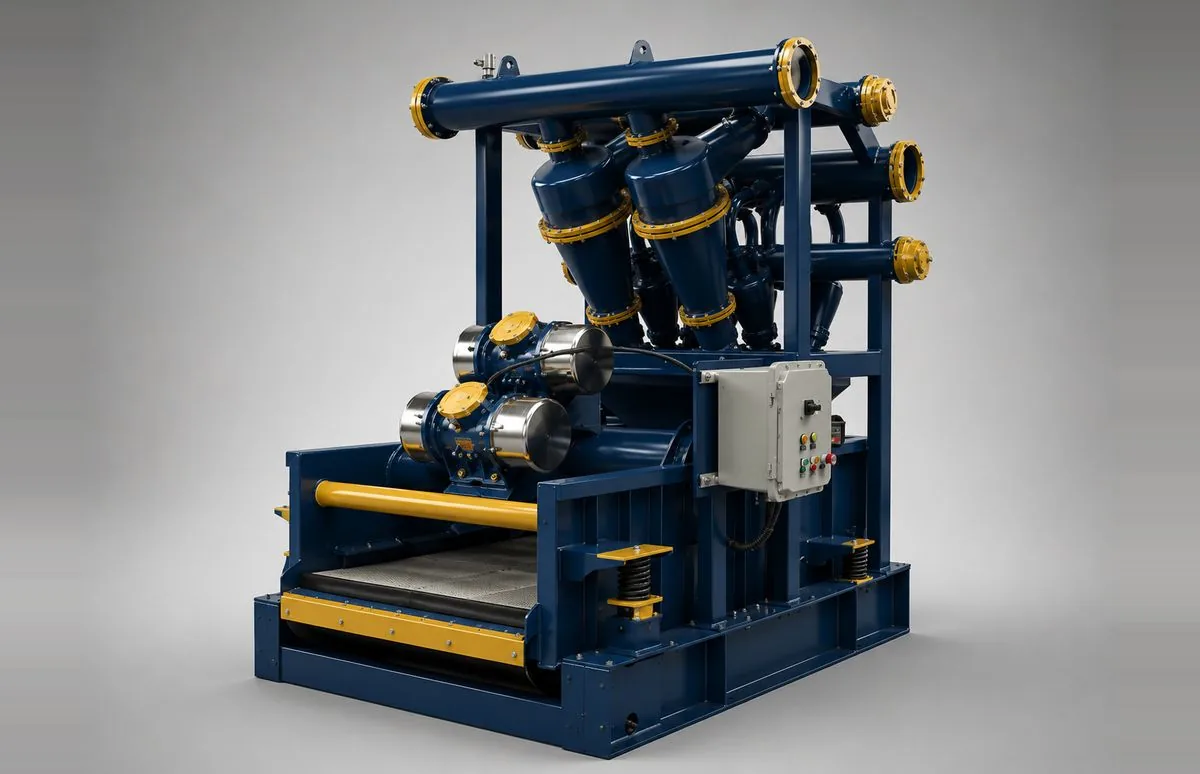
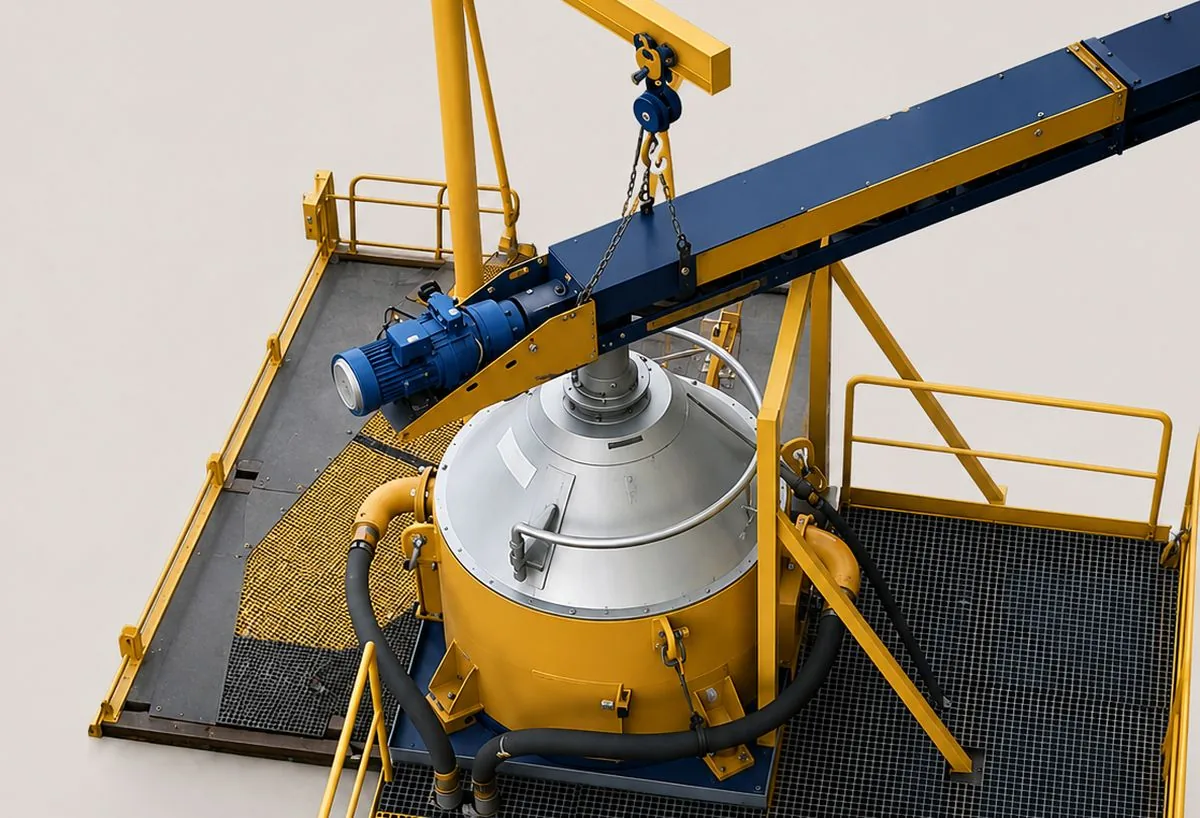
No moving parts — just pressure and geometry. Mud is pumped into a cone tangentially, spins hard, and centrifugal force throws solids to the wall and down to the apex while clean fluid spirals up and out the top.
Larger desanders catch sand-sized particles; smaller desilters reach the silt range. They live or die on feed head — drop below ~75 ft and the cut quietly fails.
A hybrid stage: a bank of desilter cones sitting over a fine-mesh shaker screen. The cones make the cut, and the underflow lands on the screen — which recovers valuable barite that plain cyclones would throw away while still rejecting fine drilled solids.
Essential on weighted muds where simply discarding the cyclone underflow would cost a fortune in lost weight material.
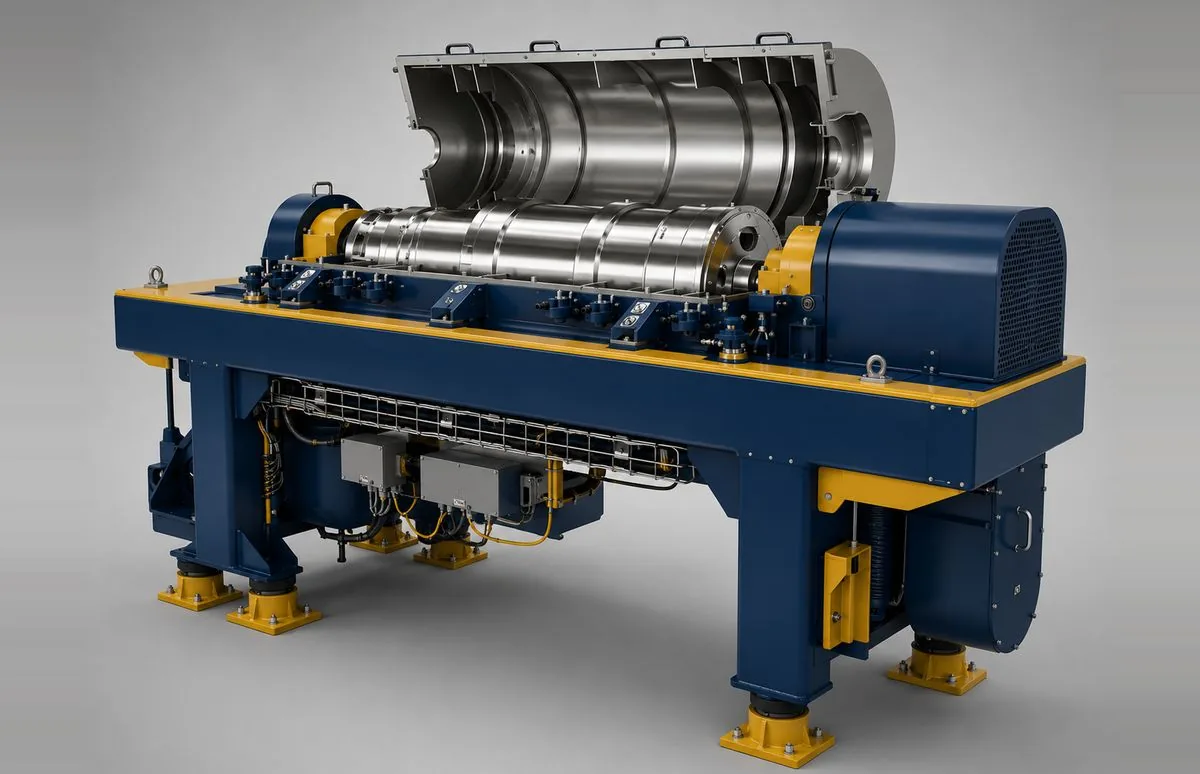
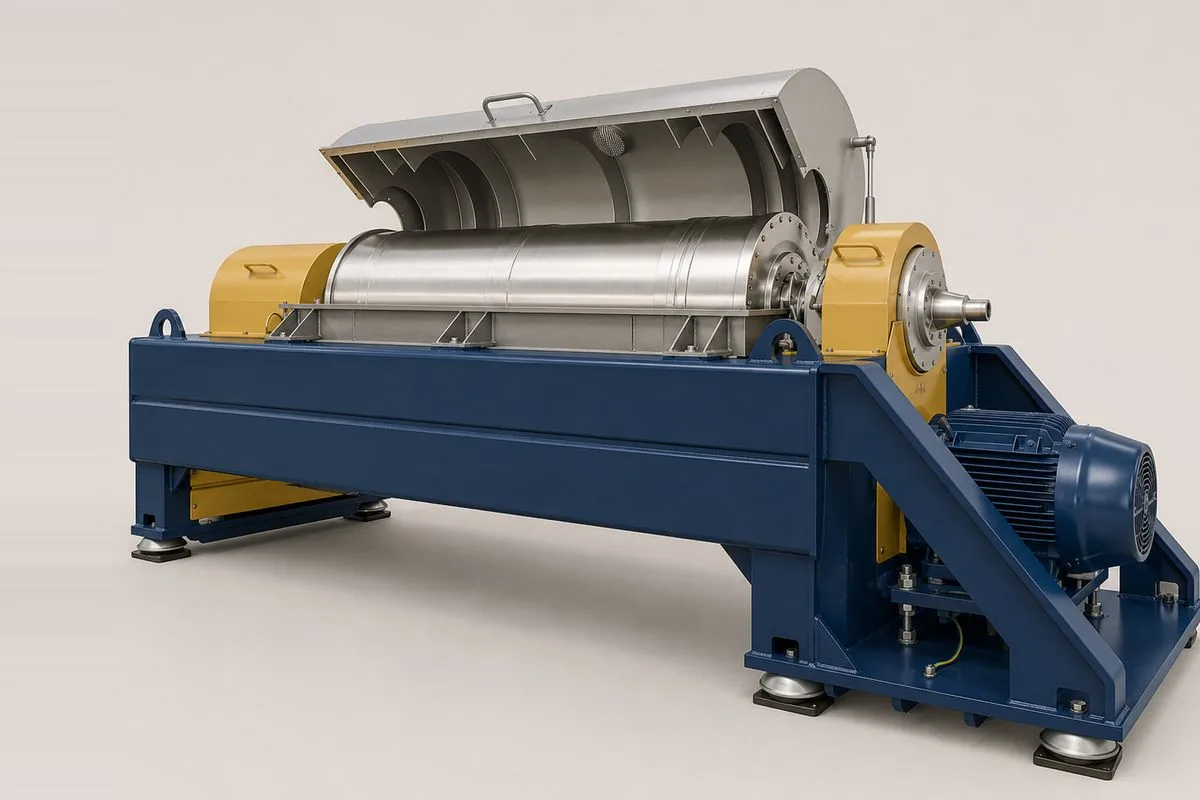
The end of the train. A high-speed rotating bowl with an internal scroll spins the slurry at hundreds to thousands of G, settling out the ultra-fine, low-gravity solids that dilution alone can't economically remove — then conveys them out one end while clarified fluid leaves the other.
Two duties, one machine: low speed for barite recovery, high speed for fine-solids dewatering. The bowl G-force you choose decides which.
Agitators and mud guns keep solids suspended in the pits so they actually reach the equipment instead of settling out and being lost downstream.
Agitator sizing is judged by turnover (TOR) — the time to move a compartment's whole volume. Too slow and weight material settles; the centrifuge pit is the usual offender.
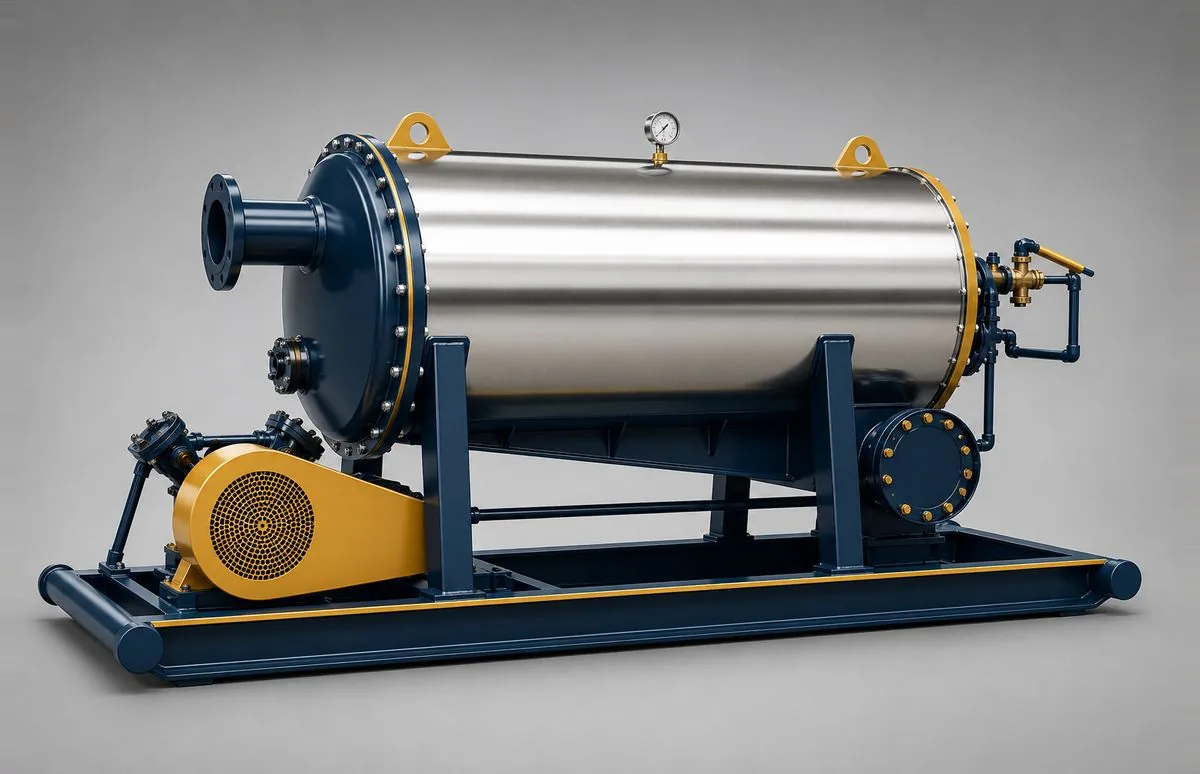
When formation gas gets entrained in the returning mud it cuts the mud weight, gasifies the pumps and throws off your weight readings. A degasser strips that gas back out before the fluid carries on through the system.
Two types do the job. A vacuum degasser pulls a vacuum on a sealed vessel and spreads the mud into a thin film over internal plates, so the reduced pressure draws the entrained gas out and vents it off. An atmospheric, centrifugal degasser achieves the same at atmospheric pressure, using a spinning rotor to throw the mud against the vessel wall in a thin film. Either way the unit sits early in the pit train — right after the shakers and ahead of the cyclone feed pump, because a centrifugal pump can't develop proper head on gas-cut mud.
Our tool kits and remote evaluations test every machine in the train against its API RP 13C target band.
See the tool kits →Before a single solid is removed, the mud has to be built, weighted and conditioned to the right density, viscosity and chemistry — and kept that way around the clock. The surface mud system is where that happens: tanks, agitation, mixing and testing working as one loop. Get the fluid right and everything downstream — the well, the shakers, the waste — gets easier.
Fluid returning from the well is cleaned by solids control, then conditioned and stored before it's pumped back down. The mud system is the platform that holds, stirs, mixes and measures it at every step.
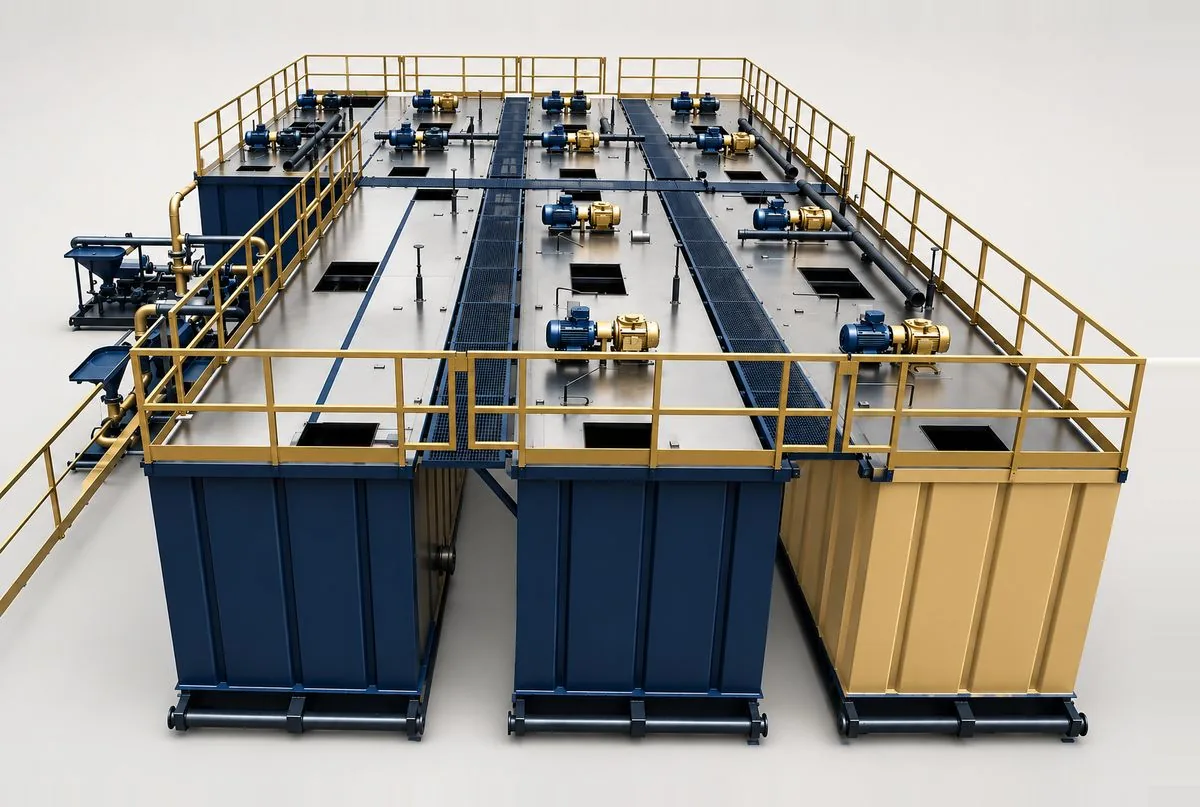
The backbone of the whole surface system. A series of engineered steel tanks — often split into dirty (settling/suction) and clean (active) compartments — that hold enough fluid for continuous circulation. Every other piece of kit sits on or feeds these tanks; they're the platform the whole solids-control and mixing process runs on.
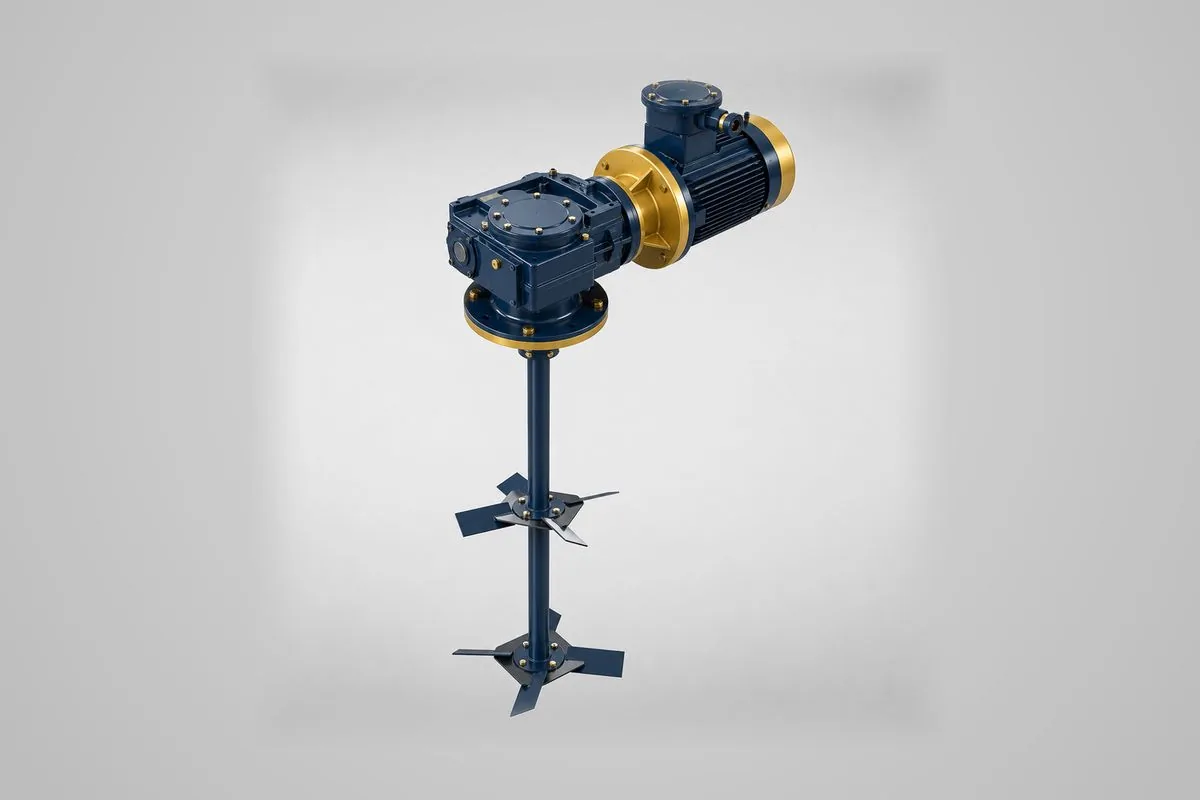
Mud left still settles — barite drops out, solids pack the bottom, and the density you carefully built drifts out of spec. Top-mounted blade agitators keep every compartment in constant motion so weighting material stays suspended and the fluid stays homogeneous. Quiet, unglamorous, and the difference between a tank of mud and a tank of sludge.
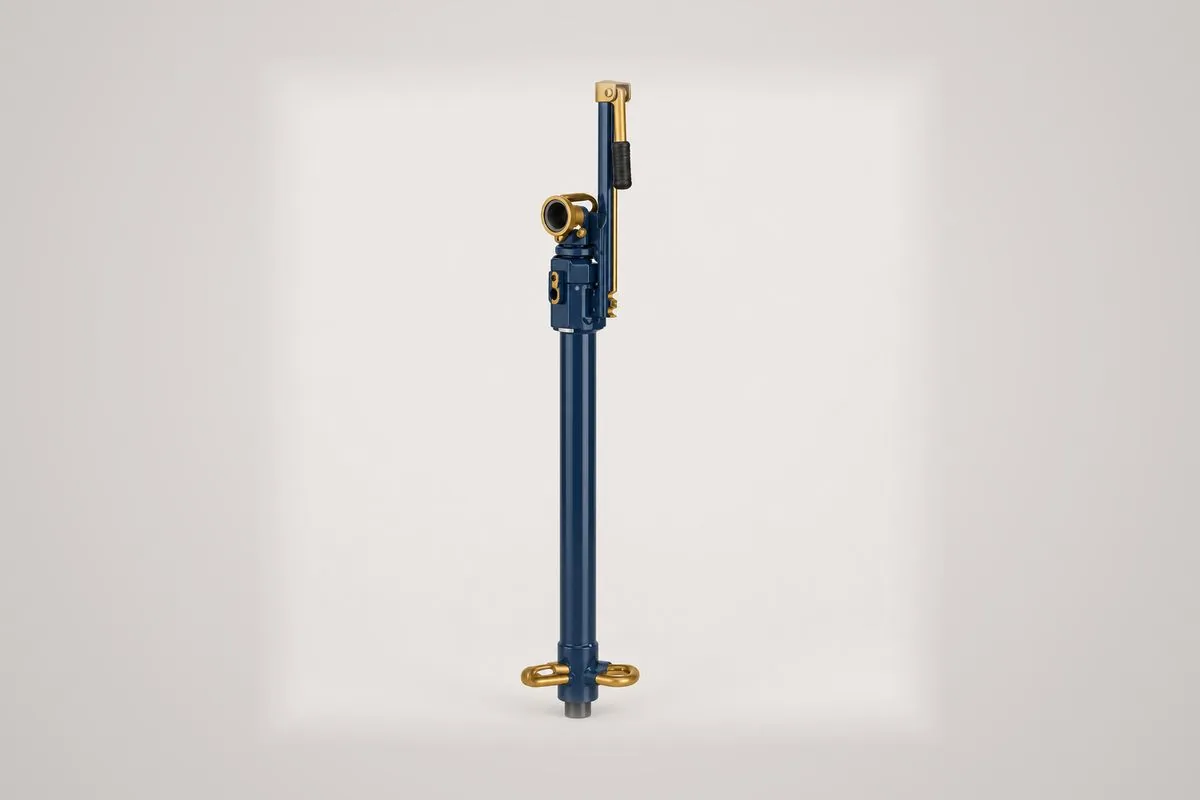
Where an agitator stirs from the centre, mud guns attack from the walls. High-velocity nozzles — usually fed off the mixing pump — sweep the tank floor and corners, breaking up the dead spots where weight material would quietly settle out. No moving parts in the tank, just directed flow aimed where the agitator can't reach.
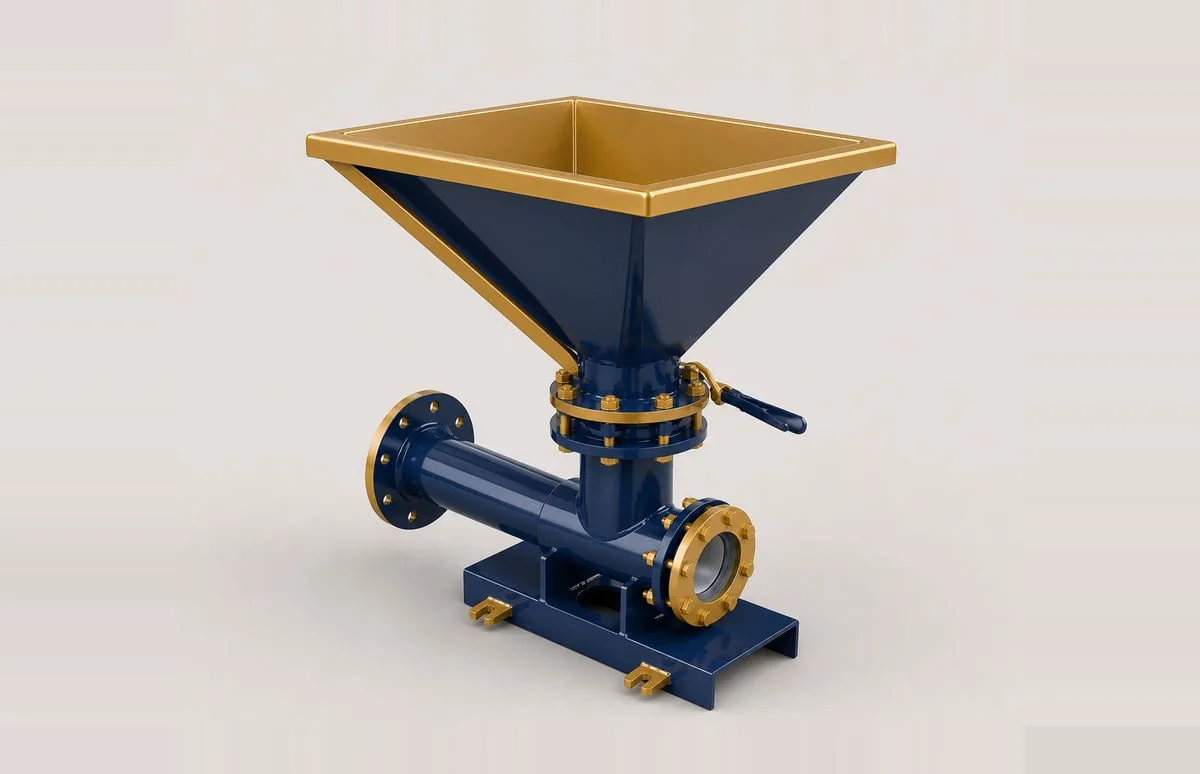
This is where mud gets made. A venturi-style hopper uses the Venturi effect — a high-velocity jet creating a vacuum — to pull dry additives like barite and bentonite into the flow and shear them instantly into the fluid. Paired with a centrifugal mixing pump, it lets you raise weight, build viscosity or treat chemistry on the fly without lumps or fisheyes.
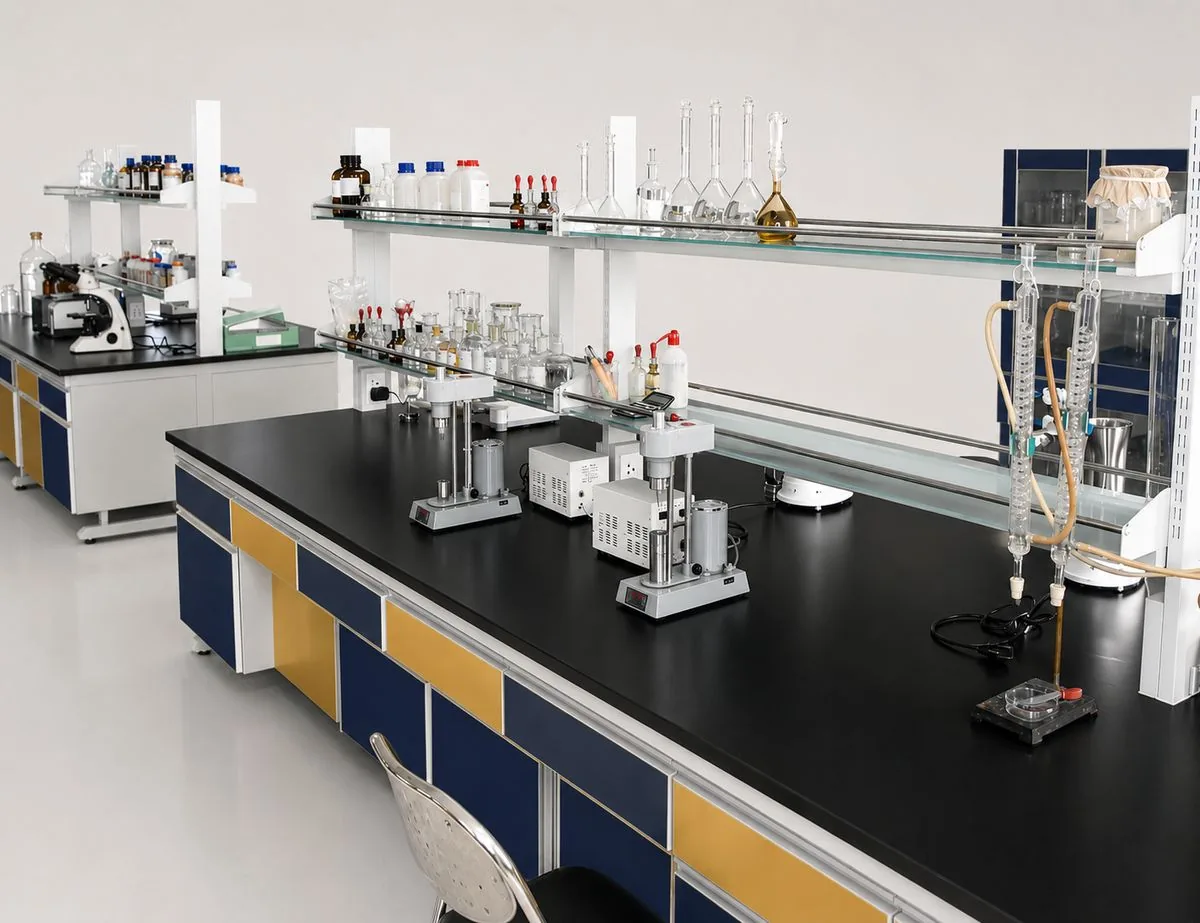
None of it matters if you can't measure it. A mud balance for density, a Marsh funnel and viscometer for rheology, a filter press for fluid loss, a retort for oil/water/solids — the lab is where the fluid's properties get checked against the program every shift. SC DrillTech's tool kits turn those readings into the same API RP 13C decisions a senior mud engineer would make.
On a small job it's one mixing pump and a tank. On a full rig it's a turnkey plant — and the same principles scale all the way up.
Bulk storage for powder additives and base fluid, with dosing feeders that meter chemicals into the hopper at a steady, accurate rate — so the mix is repeatable, not guesswork.
The muscle of the system: feed pumps supply slurry to the hoppers and cones, transfer pumps move conditioned mud back to the rig. Sizing and head matter as much here as anywhere.
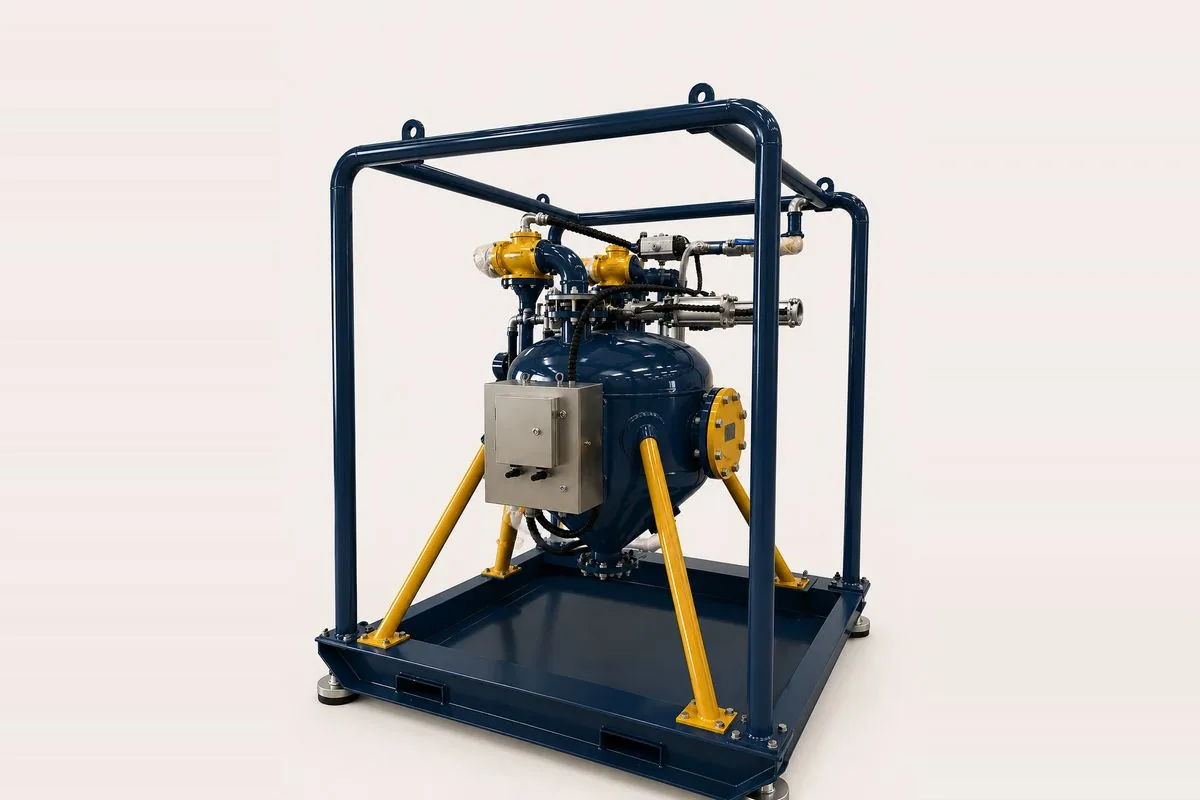
Tanks, agitators, mud guns, mixing hoppers, pumps and an electrical control system delivered as one integrated, pre-engineered package — common on HDD and modular rig builds.
The fluid you build is the fluid your solids-control train has to clean. We look at the whole loop — mixing, conditioning and separation — as one system.
See the solids-control train →Solids control cleans the active mud; drilling-waste management deals with everything that leaves the system. The chain runs in four stages — recover the fluid, move the solids, treat what remains, and dispose of it safely. Every stage has its own equipment, and every barrel recovered is money saved twice: less fluid bought, less waste hauled.
The wetter the cuttings leaving the shakers, the more fluid you lose and the more waste you pay to handle. These machines drive oil-on-cuttings (OOC) down and return recovered fluid to the system.
A shaker run at very high G-force (often 8 g and above) used as a dedicated dryer for water-based mud cuttings. It's the lower-cost first line of drying, recovering free fluid and bringing oil/water-on-cuttings down to roughly 10% before the cuttings move on.
The workhorse for oil-based mud. A high-speed vertical centrifuge with a conical screen flings the clinging fluid off the cuttings, recovering valuable base oil back to the system while dropping near-dry solids. It drives OOC down to roughly 3–5% — far below what a shaker alone can reach.
On many rigs it's the single biggest lever on both fluid cost and waste volume.
The fluid coming off the dryer still carries fine solids. A high-speed, big-bowl decanter centrifuge gives it a final solid–liquid split — recovering clean, reusable fluid and dropping the ultra-fines that would otherwise build up in the system. The same machine family used in solids control, here tuned for waste duty.
Getting cuttings from the shakers to the dryer, skip or slurry unit — contained, spill-free and documented. Increasingly a regulatory requirement, not just good housekeeping.
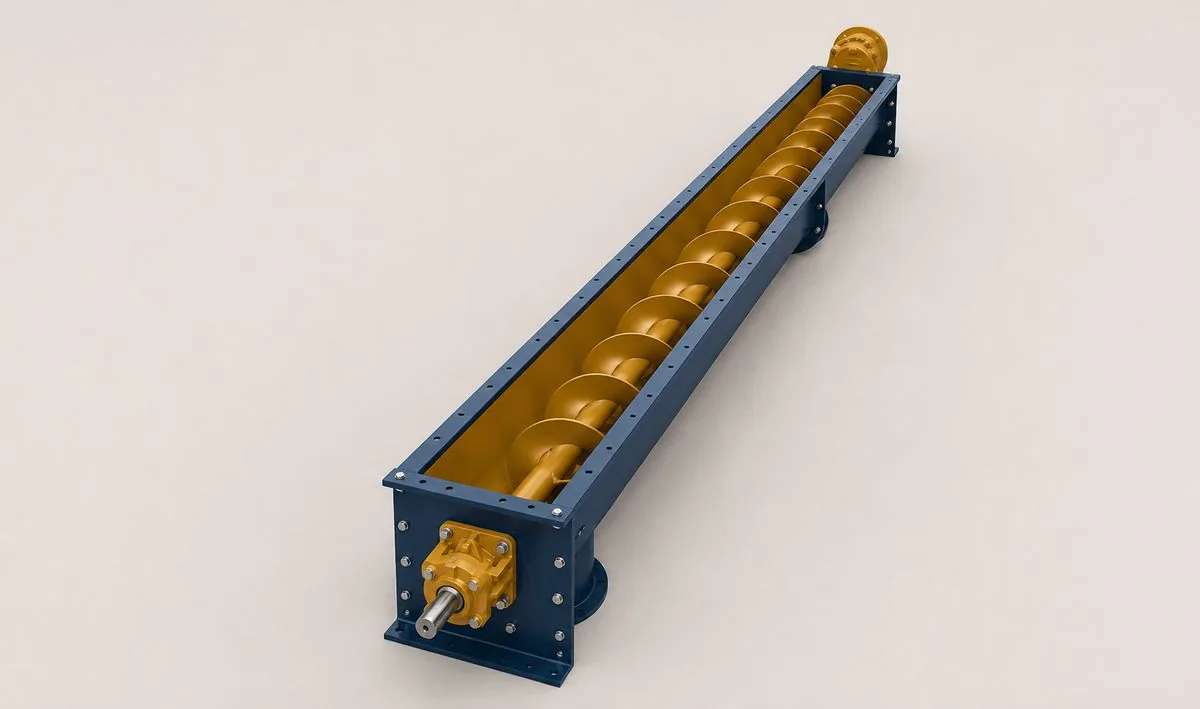
Enclosed augers carry cuttings along the deck and between machines, giving a little dewatering on the way. The simplest, most reliable transfer for short runs — fully contained, so nothing spills on the rig floor.
For longer or awkward routes, vacuum units pull cuttings through sealed lines — fully contained, with no open transfer points on the rig floor. The skid-mounted vessel draws cuttings in under vacuum, then discharges them under pressure to the next stage.
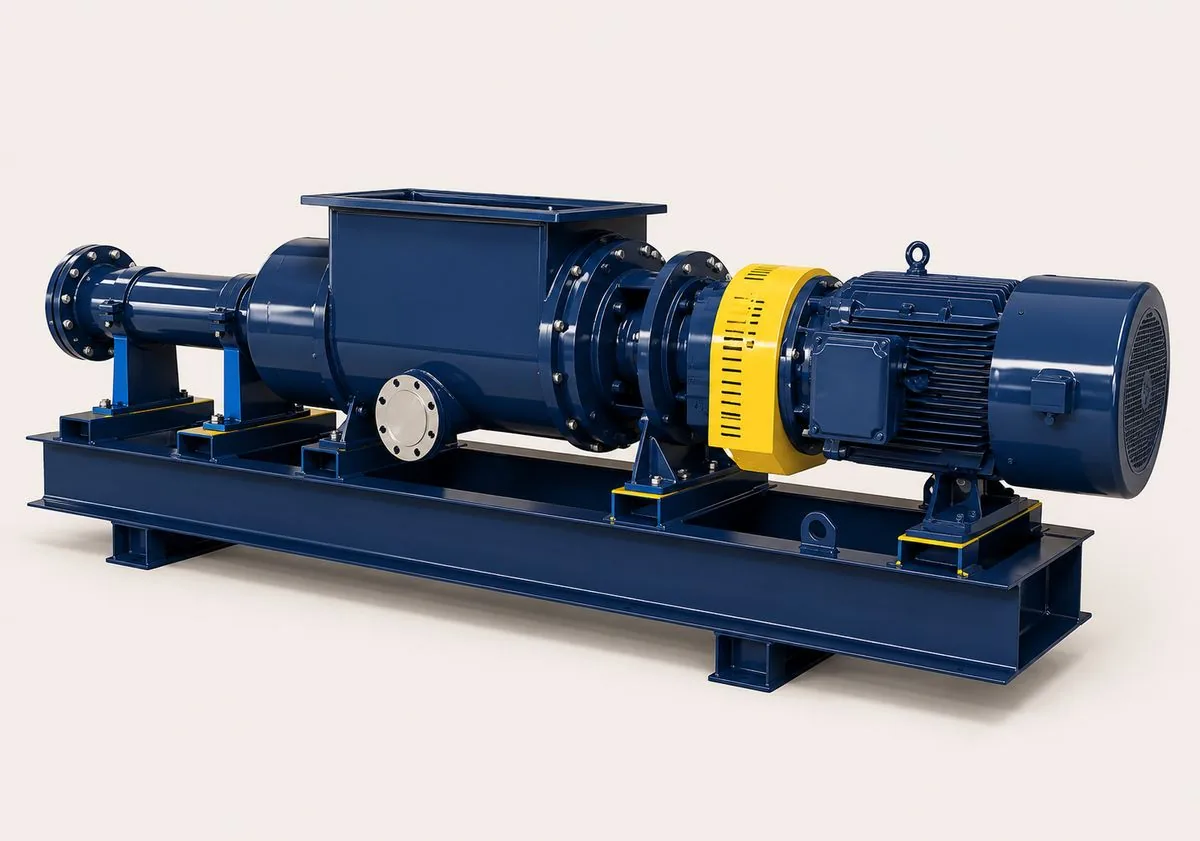
Thick cuttings slurry needs a positive-displacement pump to feed dryers and slurry units at a steady, controllable rate without shearing the solids. The progressive-cavity design moves heavy, abrasive slurry gently — ideal where a centrifugal pump would clog or churn.
After mechanical recovery, the remaining stream still carries fluid and contaminants. Treatment removes them — chemically, thermally, or both.
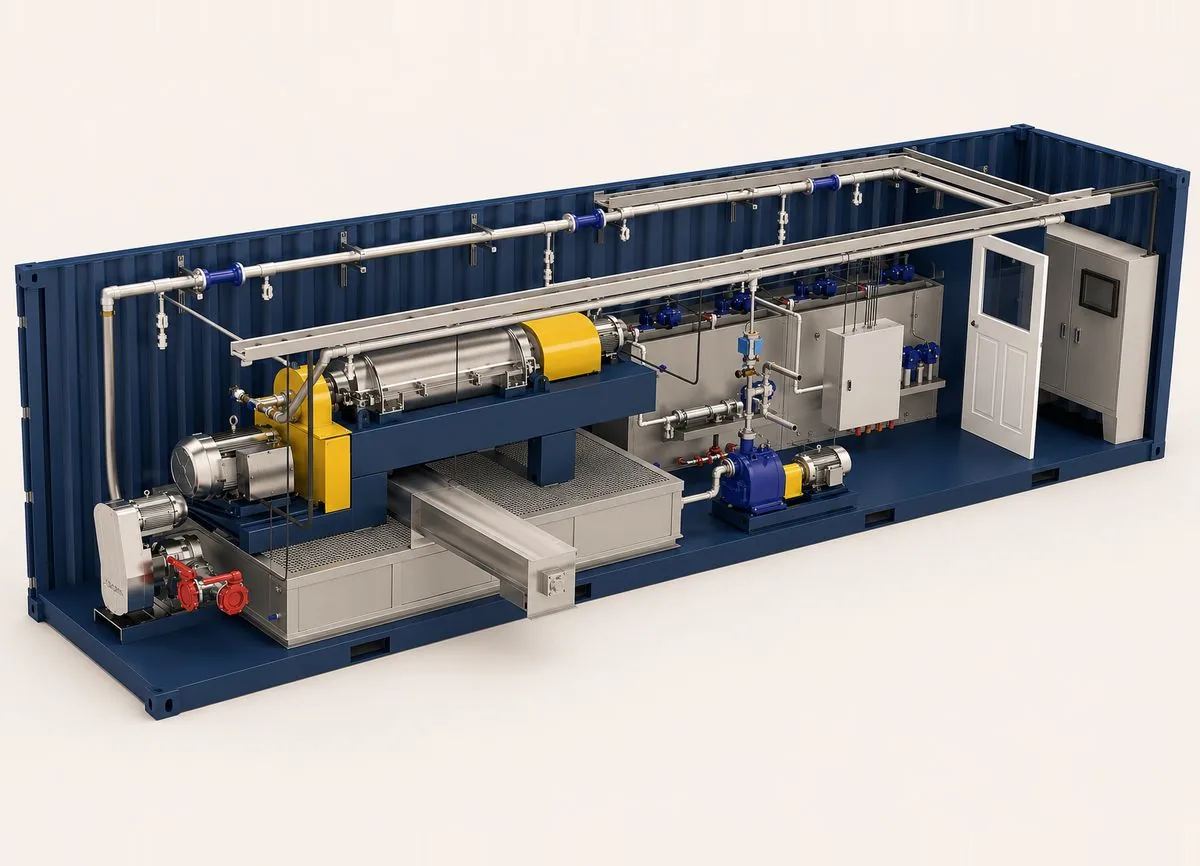
For the finest fluids a centrifuge can't fully clarify, a dewatering package adds chemistry — coagulants and flocculants — to bind ultra-fine colloidal solids into clumps a centrifuge can then drop out. The result: clarified water for reuse or discharge, and a dry cake to disposal.
Done well it closes the loop; done badly the chemistry fights you and nothing separates. Getting the coagulant/flocculant balance right is the whole game.
The most thorough treatment for oily cuttings. Indirect heat (typically a heated screw, rotating kiln or similar) drives the hydrocarbons and water off as vapour, which is then condensed and separated — recovering base oil and water while leaving inert, near-clean solids. A well-run TDU can approach a zero residual-hydrocarbon level.
It's capital-intensive and usually a base or onshore-plant operation, but it's often the only route to meeting the strictest discharge standards.
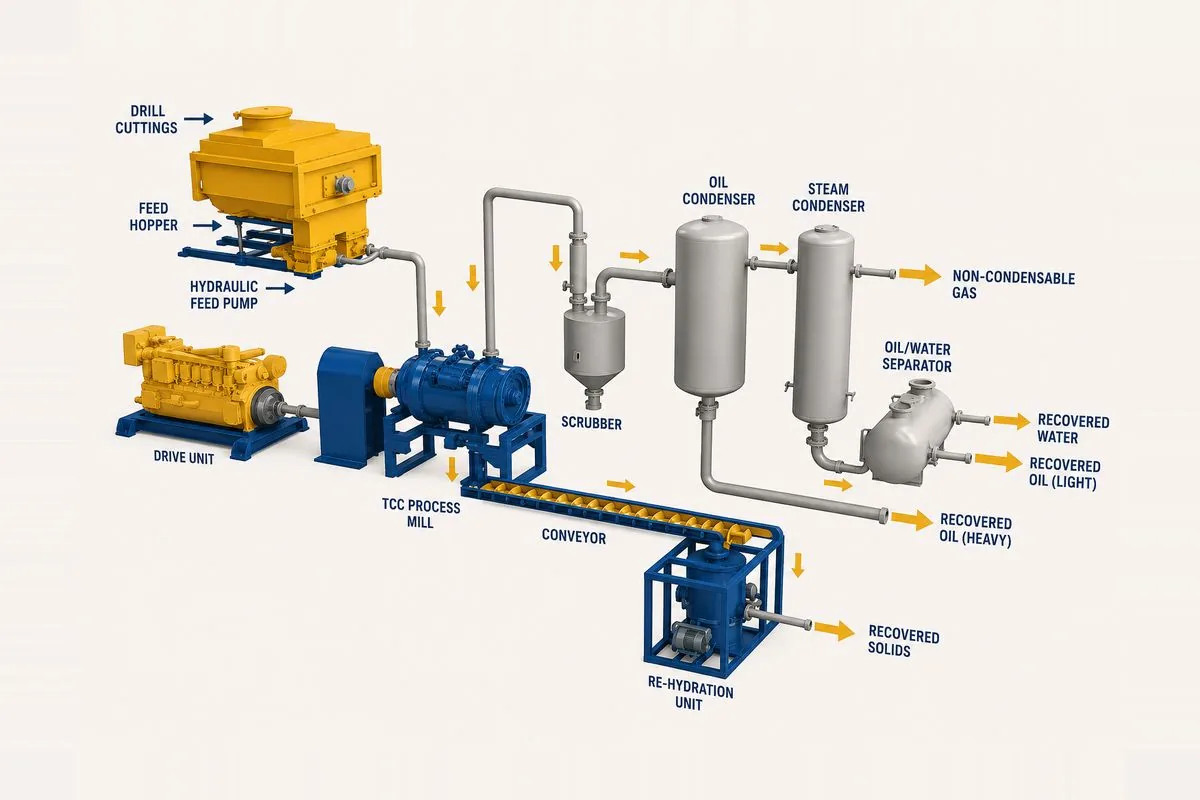
A TCC cleans oil-based-mud cuttings using heat generated by friction rather than an external flame. Hammers spinning at high speed inside the process mill heat the cuttings until the water and hydrocarbons flash off as vapour; that vapour is condensed and split into recovered oil and water, while the cleaned solids leave the mill dry.
Like a TDU it recovers base oil and water, but the mechanical heating makes it compact and offshore-capable. A well-run TCC routinely drives oil-on-cuttings below 1% — clean enough to meet most discharge limits.
Whatever can't be recovered or reused has to go somewhere. The route depends on the waste, the regulations and the site. These are the main options operators choose between.
Cuttings are ground and mixed into a stable slurry, then pumped at high pressure down a dedicated well for permanent storage in a deep formation. A slurrification unit — feed hopper, grinder, mixing tank and high-pressure injection pump — does the work, keeping the waste fully contained underground with no surface footprint.
Cuttings are blended with binders (cement, lime, blast-furnace slag) in a mixing plant to lock contaminants into a stable solid, suitable for safe burial or use as fill. Simple and widely available, though it increases the volume of material to handle.
Microbes break down residual hydrocarbons in the cuttings over time, on prepared land or in controlled cells. Low cost and low energy, but it needs space and time — best for lightly-contaminated water-based waste.
An integrated approach rather than a single machine: no reserve pit, nothing released. Solids control, drying, dewatering and containment are run together so that fluid is recovered and only treated, compliant material ever leaves site. The direction the whole industry is moving.
Most waste cost is decided upstream, at the shaker — get the active system right and the whole waste chain shrinks. We evaluate both together.
See the solids-control train →A field-engineer's map of the companies that build the equipment and run the services — from the integrated majors to the specialist manufacturers. A reference, not an endorsement.
Market figures: industry analyst estimates (Global Market Insights, SNS Insider), 2025–2026. Used for context only.
Full-service companies offering solids control and waste management as part of a wider drilling-services package.
The largest oilfield-services company; its M-I SWACO line is long associated with solids-control and drilling-fluids technology worldwide.
A global major offering drilling-fluids and waste-management services alongside its broader well-construction portfolio.
Major energy-technology company with a strong sustainability and waste-recycling emphasis in its drilling solutions.
Known for modular, mobile waste-treatment units suited to remote sites, within a full drilling-services offering.
Companies focused specifically on solids-control equipment, drilling fluids or waste handling.
Its Brandt brand designs and manufactures shale shakers, centrifuges, dryers and complete solids-control & waste-management packages.
Global drilling & completion fluids specialist — the former Newpark Resources fluids business, independent under SCF Partners since 2024.
A specialist long associated with high-performance shale shakers and fine-screen technology.
A widely-known manufacturer of complete solids-control and drilling-waste-management equipment packages.
A global leader in decanter-centrifuge design and separation technology across many industries, including oilfield.
Specialist in closed-loop and thermal cuttings-processing technologies aimed at reducing environmental impact.
Manufacturer of solids-control and drilling-waste-management equipment serving global markets.
Environmental-services firms handling drilling-waste treatment, disposal and compliance, particularly in North America.
We don't sell equipment — so our only interest is the right setting for your rig, whatever badge is on the machine.
Why that matters →Practical, field-tested writing on solids control, drilling fluids and waste management. Tap any article to read it.
What η really measures, how it's calculated from the drillers' reports, and why 70%+ is the line worth chasing.
Low feed head quietly returns fine solids to your active system. Here's the simple check that catches it.
How a worn pump and a mis-set shaker added up to real money — and what it took to recover it.
Choosing the right duty for your centrifuge, and what the cut point really depends on.
From wet discard to mis-sized dryers — the avoidable losses we see most often.
API RP 13C screen labelling, conductance and how to match a screen to your section.
The quantity solids control is really managing — how to measure LGS, split it from barite, and read MBT.
Shaker → degasser → desander → desilter → centrifuge — and why getting the order right beats raw capacity.
Vertical dryer vs high-G shaker, what drives OOC up, and why the dryer is the biggest recovery on an OBM well.
EPA, OSPAR and ROPME discharge limits, zero-discharge and the waste hierarchy — and why efficient solids control is the cheapest way to comply.
How clean mud protects rate of penetration, bit and pump life, and the AFE — the business case for treating solids control as performance, not overhead.
From hand-judged mud and gravity settling pits to borrowed mining screens and the modern centrifuge — and the one principle that never changed.
Solids accumulation, plugging, poor greasing, missed flushing and the untrained operator behind almost every centrifuge failure.
What “sand” really means, running it flowline-vs-suction, and the fines blind spot a clean reading hides.
A brilliant consistency check and a useless rheometer — why you should never design hydraulics from a funnel number.
Linear vs balanced elliptical, reading G-force, and why a tired motor defeats the best screen on the deck.
η, dilution, LGS, sand, feed head, centrifuge hours — the one-page report that turns readings into a trend.
Cone diameter sets the cut — sizing the bank for full flow, coarse-before-fine order, and the mud-cleaner fix on weighted mud.
Aerated mud kills the cyclone feed pump’s head and the cones’ air core — why it sits before the pump (atmospheric & centrifugal).
Why fine solids won’t separate alone, the strict coagulant-then-flocculant order, and finding the dose in a beaker first.
The size ladder behind every screen label and cone cut — sand, silt, colloidal — and why density rides alongside size.
Compartments are the sequence and agitation makes it real — short-circuits, barite sag, slug-feeding the centrifuge, and turnover ratio.
Why an idle centrifuge is dilution by another name — matching feed rate and hours to the fines the section generates.
No reserve pit means every barrel is cleaned, reused or hauled — why closed-loop exposes the solids-control faults a pit hid.
The solid you protect, not remove — why size can’t separate barite from drilled silt, and why sag is a suspension failure.
How to measure ROC in the field per API RP 13C and EPA 40 CFR 435 — the procedure, what the numbers mean, and why it is the compliance gate on every NAF well.
How a desilter bank plus underflow screen returns barite to the active system — and why bare desilters on weighted mud cost you weight material every tour.
Slurrification, annular vs dedicated disposal well, injection pressure and UIC permitting — the zero-discharge route when discharge is banned and haul-out is impractical.
Shakers, cones, centrifuge, pits and cuttings handling — a field checklist with the cost consequence of each fault left unfound.
PV measures solids volume; YP measures reactivity — how to read each independently and which tool fixes which problem.
OOC joins LGS as the primary metric, the VCD becomes mandatory, and the waste stream is classified oily waste — what shifts on an OBM or SBM programme.
How high LGS and reactive clay build the filter cake that holds the pipe — the levers that reduce sticking risk before the pipe goes in the hole.
LTTD, HTTD and TCC — how each type drives OOC below 1%, when thermal treatment is the required solution, and why the VCD always goes first.
How temperature-driven fluid drift, barite sag and narrow ECD windows make every LGS point count more on a high-pressure high-temperature well.
Solids raise PV, PV raises annular friction, friction raises ECD — quantifying what each LGS point is worth in ppg of margin in a tight drilling window.
More articles added regularly. Want a topic covered? Suggest one →
Want this analysis run on your own rig data? The same method is built into the SC DrillTech tool kits, or request a remote evaluation.
Representative outcomes from SC DrillTech evaluations and tool kits. Figures are illustrative of the method; your numbers depend on your rig and section.
A worn desilter feed pump and an under-set shaker were inflating dilution. Re-impellering and re-screening — verified against API RP 13C — lifted removal efficiency, cut daily dilution and recovered drilling fluid that was heading to waste.
Manifold pressure had drifted to 41 psi (66 ft head). A fresh impeller brought it to 49 psi and the cones back onto their design cut point.
The centrifuge compartment was turning over in 96 s and dropping weight material. An upsized impeller brought it inside the 85-second band.
Start with a remote evaluation and we'll show you where your savings are.
Request an evaluation →SC DrillTech is an independent solids-control, drilling-fluids and drilling-waste-management practice — not affiliated with, owned by, or operated on behalf of any drilling operator or service company. Founded by Othman Soliman, with 26+ years on land and offshore rigs across the GCC and MENA.

We bring rig-floor experience and an API RP 13C method to solids control, drilling fluids and waste management — and we package that knowledge into tool kits, reports and advice any operator can use. SC DrillTech is an independent practice: it is not owned by, affiliated with, or acting on behalf of any operator or service company. It is led by Othman Soliman, a Solids Control & Drilling Waste Management specialist with 26+ years across land and offshore operations in the GCC and MENA — in field, technical-lead and rig-evaluation roles across leading drilling-services companies — NOV (Brandt), M-I SWACO, SLB and Halliburton — and on the operator side of drilling operations. That breadth across every side of the rig is exactly what keeps the guidance vendor-neutral. He has evaluated and commissioned solids-control and mud systems on dozens of rigs, produced fluid-processing layouts and survey drawings in AutoCAD, and built technical-training programmes for operators and service companies. Any technical information shared with SC DrillTech stays confidential to SC DrillTech — it is not collected for, shared with, or accessible to any operator or service company.
Solids control and drilling-waste management sit at the centre of a multi-billion-dollar global industry — and it's growing, driven by deeper wells, tighter environmental rules, and operators chasing every barrel of fluid back out of the cuttings.
Figures synthesised from public market-research summaries (Global Market Insights; SNS Insider), 2025–2026. Estimates vary by scope and methodology — directional, not exact.
Solids-control & drilling-waste-management market size, by year — steady growth on the back of drilling activity and stricter waste rules.
Regional shares and country ranking are directional estimates synthesised from public industry reports; the US is consistently reported as the single largest market, led by Texas and North Dakota shale activity.
The shifts shaping solids control and waste management right now.
Sensors on shakers and centrifuges now stream G-force, screen condition and capture rate live — letting crews catch a failing stage in minutes instead of shifts. A growing share of R&D spend is going into smart, connected equipment.
Stricter recordkeeping, LDAR and disposal rules are pushing operators to invest earlier in solids control and cuttings handling — cutting the volumes that later need treatment, and proving compliance when auditors arrive.
Zero-discharge closed-loop systems and cuttings reinjection (CRI) are spreading, especially offshore and in sensitive areas — keeping fluid on location and reducing disposal mileage.
High-G drying shakers, vertical cuttings dryers and dewatering units are increasingly standard — recovering valuable base oil and barite that older spreads simply discarded.
Whether you're optimising an existing spread or planning a new one, we help you measure, recover and document — the three things this market now rewards.
See our services →A dedicated space for solids-control, drilling-fluids and waste-management suppliers to put their products and equipment in front of working engineers — and for our visitors to discover, react to, and discuss what's out there.
Listings from partner suppliers. SC DrillTech showcases these for discovery — each is reviewed before it appears.
Submit your equipment or product below. Nothing goes live automatically — our team reviews every submission first, and approved listings appear with a verified badge.
⏳ Submissions are reviewed by SC DrillTech before they appear publicly.
During launch, showcase slots are free. Get in touch and we'll set yours up.
Reserve a free slot →Tell us about your section and equipment. We'll reply with what we'd need and exactly what you'll get back.
Enter your rig readings and get an instant equipment check against API RP 13C target bands — hydrocyclone feed head, centrifuge G-force, line velocity and screen selection. No sign-up, runs in your browser.
Straight answers to the questions operators ask most — about solids control, drilling waste, the standards we work to, and how we work with you.
Every symbol, term and unit used across the site — solids control, drilling fluids and waste management — defined in plain field language.
How SC DrillTech handles the information you choose to share with us.
Last updated: 2026.
We only collect the information you choose to give us. When you use the contact form or request an evaluation, that is typically your name, email address, company and the message you send. When you request the field guide or a sample report through a tool, it is your email address. We do not ask for sensitive personal data.
We use your information solely to respond to your enquiry, send the materials you asked for, and follow up about a possible evaluation or engagement. We do not sell, rent or trade your information, and we do not use it for unrelated marketing.
Form submissions are delivered to us through a third-party form service. Hosting and any analytics providers may process basic technical data (such as your browser type and approximate region) to keep the site running and understand general usage. These providers act on our behalf and are not permitted to use your data for their own purposes.
We keep enquiry information only as long as needed to handle your request and any resulting relationship. You can ask us at any time to see, correct or delete the information we hold about you by emailing info@scdrilltech.com.
The site uses only the cookies needed to function and, where enabled, basic analytics. You can control cookies through your browser settings.
Questions about this policy? Email info@scdrilltech.com. This notice is provided for transparency and is not legal advice.
The basis on which this site and our reference tools are provided.
Last updated: 2026.
This website presents SC DrillTech’s services and educational material on solids control, drilling fluids and drilling-waste management. It is provided for general information.
The calculators, tool kits, articles and target bands on this site are general engineering references aligned to API RP 13C, 13B and 13D. They are intended to support judgement on the rig — they are not a substitute for site-specific engineering, and outcomes depend on your fluid programme, equipment, waste stream and local regulations.
The content is provided “as is”, without warranties of any kind. While we work to keep it accurate, SC DrillTech does not guarantee that any figure, method or recommendation will produce a particular result on a given well.
Site content, tool kits and written material are the property of SC DrillTech unless stated otherwise. Company and product names mentioned for reference are trademarks of their respective owners; SC DrillTech is independent and not affiliated with, endorsed by, or partnered with any company named.
To the extent permitted by law, SC DrillTech is not liable for any loss arising from reliance on the general information or tools on this site. Paid engagements are governed by the specific agreement made for that work.
We may update these terms as the site and services evolve. Continued use of the site means you accept the current version.