Straight answers · Solids control · Drilling fluids · Waste · Mud plants
Solids control & drilling fluids, answered.
Clear, field-tested answers to the questions engineers, students and operators ask most — across the whole circuit and the fluids that run through it. Each answer leads with the point: the definition, the cause, the fix. No filler.
72 questions · 11 topicsSolids control — the basics
What is solids control in drilling?
Solids control is the process of removing drilled solids from drilling fluid so the fluid can be reused. It uses a sequence of equipment — shale shakers, hydrocyclones (desanders and desilters) and decanter centrifuges — each removing progressively finer particles. Effective solids control lowers dilution cost, protects mud properties and reduces waste.
What equipment is used for solids control?
The solids-control circuit, in order of removal, is: shale shakers (coarse, the primary stage), hydrocyclones — desanders then desilters (medium to fine), a mud cleaner (cyclones over a fine screen, used on weighted mud), and a decanter centrifuge (the finest cut). A vacuum degasser and the mud tanks support the train.
What is the correct order of solids control equipment?
The correct order is: shale shaker → desander → desilter → centrifuge. Each stage removes finer particles than the last, so coarse solids are taken out first to protect the downstream units. Running them out of order (for example a desilter ahead of a desander) overloads the finer equipment and wastes fluid.
Why is solids control important?
Solids control directly controls drilling-fluid cost and performance. Removing drilled solids mechanically is far cheaper than diluting them away, so good solids control cuts daily dilution volume, keeps plastic viscosity and mud weight in range, improves rate of penetration and reduces the volume of waste that must be treated and disposed of.
What is removal efficiency in solids control?
Removal efficiency is the share of drilled solids that the solids-control equipment takes out before the fluid returns to the active system. Higher efficiency means fewer solids recirculated, so less dilution is needed and mud properties stay in range. It is the single best measure of how well a solids-control train is performing.
What does cut point (D50) mean in solids control?
Cut point is the particle size at which a separation device removes 50% of particles (the D50) — half that size go to discard, half pass through. A finer cut point means smaller particles are removed. It is the consistent way to compare shaker screens (per API RP 13C) and to describe what a cyclone or centrifuge achieves.
What are low-gravity solids (LGS)?
Low-gravity solids (LGS) are drilled solids and clays with a specific gravity around 2.6. High-gravity solids (HGS) are weighting material such as barite, around 4.2. Solids control exists mainly to remove LGS while keeping the valuable HGS; excess LGS thickens the mud, raises dilution cost and slows drilling.
What is the difference between drilled solids and colloidal solids?
Drilled solids are all the rock particles generated by the bit. Colloidal solids are the ultra-fine fraction (roughly below 2 microns) that no mechanical equipment can remove and that drives plastic viscosity. This is a key point many operators miss: mud performance and PV are controlled by colloidal content, not by total low-gravity solids.
What is a sand trap in the mud system?
A sand trap is the first, unstirred compartment directly under the shale shakers. Solids that pass the screens settle there by gravity before the fluid moves on to the degasser and cyclones. It is dumped periodically. It is the only tank that should not be agitated, so settling can happen.
Shale shakers
What does a shale shaker do?
A shale shaker is the first and most important solids-control device. It passes drilling fluid over vibrating screens that separate coarse drilled cuttings from the mud: cuttings travel off the screen to discard while the fluid falls through to the active system. Shaker performance sets the load on every downstream unit.
What is screen blinding on a shale shaker?
Screen blinding is when near-size particles lodge in the screen openings and block them, so fluid can no longer pass and pools on the deck. It is common in fine, sticky or clay-rich sections. Fixes include changing mesh, using layered or three-dimensional screens, and managing the reactive solids upstream.
What is shaker G-force and what is a typical range?
Shaker G-force is the acceleration the screen surface delivers to move cuttings and throughput, set by stroke and rotation speed. A typical linear-motion shaker runs around 4–8 G per the manufacturer's rating. Too little G under-conveys and floods; too much accelerates screen and bearing wear.
What does shaker screen mesh and API number mean?
Mesh counts openings per linear inch, but weave and wire thickness change the actual opening, so mesh alone is not comparable between screens. The API number (per RP 13C) labels a screen by its measured separation cut point, which is comparable across vendors. Always compare screens by API number, not raw mesh.
What causes wet cuttings coming off the shaker?
Wet cuttings usually mean the cuttings are not given enough time or G-force to dry on the screen: screens too coarse, deck angle wrong, fluid overloaded, or shaker undersized for the flow. The fix is to match screen and G-force to the load, correct the deck angle, and avoid running flooded.
What is linear vs balanced elliptical motion on a shaker?
Shaker motion describes how the deck moves the cuttings. Linear motion gives straight-line strokes and strong conveyance, good for high solids loads. Balanced elliptical motion is gentler on screens and helps in sticky sections. The motion, stroke and speed together set the G-force and conveyance the shaker delivers.
What is a possum belly (back tank) on a shale shaker?
The possum belly, or back tank, is the header box at the end of the flowline that feeds the shale shakers. It receives returns from the well and distributes them evenly across the shaker screens. It needs a calm, full-width overflow — not a jet — and clean-out access, or solids settle and shakers are starved or flooded.
Hydrocyclones — desanders, desilters & mud cleaners
How does a hydrocyclone work?
A hydrocyclone spins fluid under feed pressure so heavier solids move to the wall and exit the bottom apex as underflow, while cleaned fluid leaves the top as overflow. Larger desander cones remove sand-sized solids; smaller desilter cones remove finer silt. The correct underflow is a light spray, not a rope.
What is the difference between a desander and a desilter?
Both are hydrocyclones; the difference is cone size and cut. A desander uses larger cones (typically 6–12 inch) to remove sand-sized solids and runs first. A desilter uses smaller cones (typically 4 inch or less) to remove finer silt and runs after the desander. Smaller cones make a finer cut.
What does roping mean on a hydrocyclone?
Roping is when a hydrocyclone underflow discharges as a thick rope instead of a fine spray. It signals the cone is overloaded — too many solids for the apex — so solids are bypassed to overflow and removal collapses. The fix is to reduce solids load, open or replace the apex, or add cones.
What feed head should a hydrocyclone run at?
Hydrocyclones are designed for a specific feed head, commonly around 75 feet (about 32 psi) for typical units. Too little head and the cut weakens and underflow ropes; too much head wastes energy and erodes the apex. Feed pressure should be checked at the manifold and matched to the cone design.
What is the correct underflow shape on a hydrocyclone?
The correct underflow is a fine, umbrella-shaped spray with a hollow centre that draws a little air — this means the cone is working at capacity without bypassing solids. A solid rope means it is overloaded; a wide wet spray means the apex is too open and fluid is being wasted.
What is a mud cleaner and when is it used?
A mud cleaner is a bank of desilter cyclones mounted over a fine shaker screen. The cyclones concentrate solids and the screen recovers the underflow, returning barite-sized particles to weighted mud while discarding fine drilled solids. It is used on weighted (barite) mud where a plain desilter would throw valuable barite away.
Why should hydrocyclones not run on weighted mud?
Plain desanders and desilters cut by particle size, not density, so on weighted mud they discard barite (a valuable, sand-sized solid) along with drilled solids. On weighted systems, a mud cleaner — cyclones over a fine screen — or a barite-recovery centrifuge is used instead so barite is returned and only fine drilled solids leave.
Centrifuges & degassers
What does a decanter centrifuge do in drilling?
A decanter centrifuge makes the finest mechanical cut in solids control. A bowl spins at high speed while an internal scroll conveys settled solids out one end and clarified fluid out the other. On unweighted mud it removes fine drilled solids; on weighted mud it can recover and return barite.
What G-force does a decanter centrifuge generate?
A decanter centrifuge generates high G-force by spinning its bowl at speed. Middle-speed units (around 1,600–2,000 rpm, roughly 800 G) are used for barite recovery; high-speed units (around 2,500–3,200 rpm, up to about 2,000+ G) make a finer cut to remove low-gravity fines. Higher G captures smaller particles.
What is the centrifuge cut point on drilled solids?
A decanter centrifuge typically cuts in the 2–10 micron range on drilled solids, depending on bowl speed, pond depth and feed rate. Higher G and longer retention push the cut finer; higher feed rate and shallower pond make it coarser. It is the finest mechanical separation in the solids-control train.
How does barite recovery with a centrifuge work?
Barite recovery uses centrifuge speed to separate by density. A first, lower-speed centrifuge (around 800 G) drops out the denser barite and returns it to the active mud, while its overflow goes to a second, high-speed centrifuge that discards the lighter fine drilled solids. Recovery of barite can exceed 90%.
What is pond depth (weir setting) on a centrifuge?
Pond depth is the depth of liquid held in the bowl, set by the overflow weirs. A deeper pond gives longer settling time and clearer overflow but a wetter cake; a shallower pond gives a drier cake but a less clean cut. Pond depth, bowl speed and differential are the three main tuning levers.
What is differential (conveyor) speed on a centrifuge?
Differential speed is the speed difference between the bowl and the internal scroll, which controls how fast settled solids are conveyed out. Too high and the cake is wet and removal drops; too low and torque rises until the unit trips. It is tuned to the solids load and watched through the conveyor-torque trend.
Why does a decanter centrifuge trip on high torque?
High-torque trips usually mean the scroll cannot move the solids load it is being fed. Common causes are differential (conveyor) speed set wrong for the load, scroll-flight wear, feed rate too high, or solids too heavy and wet. The first check is to trend conveyor torque and the differential set point against the load.
What does a vacuum degasser do?
A vacuum degasser removes small amounts of entrained gas from drilling fluid to restore its true density, protect the centrifugal pumps from gas-locking, and keep mud weight readings accurate. It handles low-level entrained gas — not a well-control influx, which must go to the mud-gas separator (MGS).
What is a mud-gas separator (MGS) and how is it different from a degasser?
A mud-gas separator (MGS, or poor-boy degasser) handles large volumes of gas from a well-control influx, venting it safely up a flare line. A vacuum degasser only removes small amounts of entrained gas to restore mud density. Kick gas must go to the MGS — never to the vacuum degasser.
Pumps & the mud system
Why do centrifugal pumps feed the solids-control equipment?
Hydrocyclones and mud cleaners need a steady feed pressure (head) to make their cut, and that is provided by dedicated centrifugal pumps — one sized per cyclone bank. The pump must deliver the design head without cavitating; an undersized or starved pump collapses the cyclone cut and wastes the whole stage.
What is NPSH and why does it matter for mud pumps?
NPSH (net positive suction head) is the suction pressure available to a pump above the fluid's vapour pressure. If available NPSH falls below what the pump requires — from a low suction tank, gas-cut mud or a restricted line — the pump cavitates, losing flow and damaging the impeller. Good suction design prevents it.
How is mud kept uniform in storage tanks?
Stored mud is kept uniform by mechanical agitators and circulating eductors (mud guns) sized to the tank, which keep barite and solids suspended and prevent settling beds and dead zones. Without enough agitation, barite sags to the bottom and the mud delivered is off-weight and inconsistent.
What is barite sag?
Barite sag is the settling and segregation of weighting material, leaving heavier mud low and lighter mud high in the well. It causes mud-weight swings, stuck pipe and well-control risk. It is worse in high-angle wells and with poor suspension or inadequate agitation.
Drilling fluids — fundamentals
What is drilling fluid (drilling mud)?
Drilling fluid, or mud, is the circulating fluid in a well. Its core jobs are: carry cuttings up the annulus, control formation pressure through its density, cool and lubricate the bit, stabilise the wellbore, suspend solids when circulation stops, and transmit hydraulic power to downhole tools.
What are the main functions of drilling fluid?
Drilling fluid performs several jobs at once: it carries cuttings up the annulus, controls formation pressure through its density, cools and lubricates the bit and drill string, stabilises the wellbore and forms a filter cake, suspends solids when circulation stops, and transmits hydraulic power to downhole tools.
What is the difference between water-based and oil-based mud?
Water-based mud (WBM) uses water as the continuous phase — cheaper and easier to dispose of, but less stable in reactive shale. Oil-based mud (OBM) or synthetic-based mud (SBM) uses oil or synthetic as the continuous phase — better lubricity, shale stability and high-temperature performance, but costlier and with stricter oil-on-cuttings handling.
What is the difference between SBM and OBM?
Both are non-aqueous fluids with an oil external phase. Oil-based mud (OBM) uses diesel or mineral oil as the base; synthetic-based mud (SBM) uses engineered synthetic base fluids that biodegrade more readily and have lower toxicity. SBM is common offshore where discharge rules are strict, while delivering OBM-like performance.
What are common drilling fluid additives?
Typical additives include bentonite (viscosity and filter cake), barite (weight), caustic soda (pH), lignosulfonate or polymers (thinners and filtration control), CMC and starch (fluid-loss control), KCl or glycol (shale inhibition), and lubricants. Each is added to tune a specific property without upsetting the others.
What is shale inhibition and why does it matter?
Shale inhibition is keeping reactive clay formations from swelling or dispersing when they contact water-based mud. It is achieved with salts (KCl), glycols, amines or by switching to oil-based mud. Poor inhibition causes hole problems, gumbo on the shakers and bit balling — and overloads solids control with sticky fines.
Drilling fluids — properties & testing
What is mud weight and how is it measured?
Mud weight is the density of the drilling fluid, set to balance formation pressure. It is measured on the rig with a mud balance and reported in pounds per gallon, specific gravity or pounds per cubic foot. It is raised with barite and lowered by dilution or solids removal; getting it wrong risks a kick or losses.
What are plastic viscosity (PV) and yield point (YP)?
From the Bingham-plastic model: plastic viscosity (PV) reflects mechanical friction between solids and is driven mainly by solids content, so a rising PV often signals a solids-control problem. Yield point (YP) reflects electro-chemical attraction between particles and governs hole-cleaning carrying capacity. Both are derived from 600 and 300 rpm viscometer readings.
What is the Bingham plastic model?
The Bingham plastic model describes drilling-mud flow with two parameters: plastic viscosity (PV), the slope from solids friction, and yield point (YP), the stress needed to start flow. PV and YP are derived from 600 and 300 rpm viscometer readings and are the everyday way rig crews track and control rheology.
What is apparent viscosity?
Apparent viscosity is the single viscosity value a fluid shows at one shear rate — for drilling mud it is taken as half the 600 rpm viscometer reading. Because mud is shear-thinning (non-Newtonian), its viscosity changes with shear rate, so apparent viscosity is only a snapshot, not the whole picture.
What is gel strength in drilling mud?
Gel strength is the mud's ability to form a structure and suspend solids when it is not flowing, measured at 10 seconds and 10 minutes per API RP 13B. Enough gel keeps barite and cuttings in suspension during connections; too much gel makes the pump fight to break circulation. It is a key control for barite sag.
What is Marsh funnel viscosity?
Marsh funnel viscosity is a quick rig-floor check: the seconds it takes one quart of mud to flow out of a standard funnel. It is a relative trend indicator, not a true rheology measurement, and is read every 15–20 minutes to catch changes between the less frequent full rheology checks.
What is filtration / fluid loss and filter cake?
Filtration, or fluid loss, is the liquid that escapes from the mud into a permeable formation, leaving a filter cake of solids on the wall. A thin, low-permeability cake protects the wellbore and limits loss; a thick or weak cake causes stuck pipe, formation damage and excess fluid loss. It is measured with API filter-press tests.
What is ECD (equivalent circulating density)?
Equivalent circulating density (ECD) is the effective mud density the formation sees while circulating — the static mud weight plus the added pressure from friction in the annulus. ECD rises with pump rate, viscosity and cuttings load; if it exceeds the fracture gradient it causes losses, so it is a key drilling-window limit.
What is dilution and why is it costly?
Dilution is adding fresh fluid to bring solids content back down when equipment is not removing enough drilled solids. Every barrel diluted is fluid and chemicals you build and then discard, so weak solids control shows up directly as daily dilution cost. Raising removal efficiency cuts that volume.
What is sand content and why is it measured?
Sand content is the percentage of sand-sized particles (larger than 74 microns / 200 mesh) in the mud, measured with a sand-content kit. High sand abrades pumps and equipment and signals weak solids control. Keeping it low protects the mud pumps, bit nozzles and the whole circulating system.
Drilling waste management
What are the main drilling-waste treatment methods?
The main methods are: mechanical separation and cuttings dryers to recover fluid; dewatering with flocculants to treat the liquid phase; thermal desorption to vaporise and recover oil from oil-based cuttings; cuttings re-injection (slurrify and pump downhole); solidification/stabilisation; and bioremediation. Choice depends on mud type, location and discharge limits.
How is drilling waste managed?
Drilling-waste management handles the solids the circuit removes. Cuttings dryers — such as vertical cuttings dryers — recover fluid and lower oil-on-cuttings; dewatering treats the liquid phase; and cuttings are collected for treatment or disposal. Lowering oil-on-cuttings reduces both cost and environmental burden.
What is a vertical cuttings dryer (VCD)?
A vertical cuttings dryer is a high-speed screen-bowl centrifuge that recovers fluid from oil- or synthetic-based cuttings. Cuttings are flung against a fine screen at high G; recovered fluid returns to the active system and drier solids discharge for disposal. It typically drives oil-on-cuttings down toward single-digit percentages.
What is thermal desorption of drill cuttings?
Thermal desorption heats oil-based cuttings, commonly to about 200–350°C, to vaporise water and oil; the vapours are condensed and the oil recovered, leaving dry residue. Properly run, it can reduce oil content in the treated solids to below 1% — meeting the typical regulatory oil-on-cuttings target.
What is dewatering in drilling-waste management?
Dewatering separates fine solids from the liquid phase of waste or whole mud using chemical coagulants and flocculants ahead of a decanter centrifuge. The polymers make fine particles clump so the centrifuge can capture them, producing clarified water for reuse or discharge and a dry solids cake.
What is cuttings re-injection (CRI)?
Cuttings re-injection grinds drilled cuttings into a slurry and pumps them down a dedicated injection well into a contained formation. It avoids surface discharge and is used where regulations or logistics rule out other disposal — but it needs careful slurry design and pressure control to avoid leak-off.
What is retention on cuttings (ROC) / oil on cuttings (OOC)?
Retention on cuttings (ROC), also called oil on cuttings (OOC), is the amount of base oil or fluid clinging to discarded drilled cuttings, measured by the gravimetric wet/dry method. It drives both fluid loss and discharge compliance; lower ROC means lower cost and easier compliance with limits such as EPA 40 CFR 435.
What is the oil-on-cuttings (OOC) discharge limit?
Many offshore regimes require oil retained on discharged cuttings to be below about 1% by weight (regulations vary by region). Treatment such as cuttings dryers and thermal desorption is used to reach this. Tracking retention-on-cuttings by the gravimetric method is how compliance is demonstrated.
What is the waste hierarchy in drilling-waste management?
The preferred order is: reduce waste at source (better solids control and fluid design), reuse and recover (recover base oil and barite, reuse fluid), treat (dry, dewater, thermally treat), and only then dispose (landfill, injection, secure disposal). Lower oil-on-cuttings and higher recovery move waste up this hierarchy and cut cost.
Mud plants & bulk systems
What is a liquid mud plant (LMP)?
A liquid mud plant is a shore-based or offshore facility for producing, storing, delivering and receiving drilling fluids and brines. It blends and weights mud, stores it in large tanks, loads supply vessels, and can receive, clean and recondition returned fluid — including barite recovery. It is the supply hub behind rig mud.
What equipment makes up a liquid mud plant?
A liquid mud plant typically includes barite and bentonite bulk silos, jet hoppers and shearing units for mixing, agitated storage tanks, transfer and centrifugal pumps, shale shakers and centrifuges for reconditioning, a dust-collection system, and pipework manifolds for loading and receiving fluid from vessels.
How is barite stored and handled in bulk?
Barite and bentonite are stored as dry powder in pressure silos, often with a bottom weighing device for accurate batching. They are moved by pneumatic conveying — fluidised with compressed air and pushed through pipes — and metered into the mixing system. Dust collection and pressure-relief protect the equipment and the environment.
What is pneumatic conveying in a mud plant?
Pneumatic conveying moves dry bulk powder (barite, bentonite, cement) through pipework using compressed air, either dense-phase (low speed, high pressure) or dilute-phase (high speed, low pressure). Airlocks or rotary valves control flow and filters separate the conveying air, allowing dust-free transfer from silo to mixing.
What is a jet hopper (eductor) in mud mixing?
A jet hopper, or eductor, mixes dry powder into liquid using a venturi: fluid pumped through a nozzle creates suction that draws powder from the hopper and shears it into the stream. It is the standard way to add bentonite and barite to build and weight mud quickly without lumps.
Why does mud need shearing when mixing?
Shearing breaks up and fully hydrates additives such as bentonite and polymers so they develop their full viscosity and yield. Under-sheared mud wastes product and gives unstable properties; proper shear through hoppers and high-shear units lets each pound of additive do its job, lowering chemical cost.
Why is dust control important in a mud plant?
Bulk barite and bentonite handling releases fine dust that is a health hazard (respirable particulate, silica) and an explosion and housekeeping risk. Dust collectors, vent filters on silos and enclosed transfer keep the air clean, protect workers and meet environmental limits — a core part of mud-plant HSE.
Standards
What is API RP 13C?
API RP 13C is the industry recommended practice for labelling and testing shale-shaker screens by separation cut point. It lets screens from different vendors be compared on a consistent basis — by the size of particle they actually separate — instead of by raw mesh count, which is not comparable across weave types.
What is API RP 13B?
API RP 13B is the recommended practice for field testing drilling fluids — 13B-1 for water-based and 13B-2 for oil-based muds. It defines the standard procedures for measuring density, viscosity, gel strength, filtration, sand content, pH and chemical properties, so results are consistent from rig to rig.
What is API RP 13D?
API RP 13D is the recommended practice for the rheology and hydraulics of oil-well drilling fluids. It provides the models and methods to relate mud rheology to flow, pressure loss and hole cleaning — the basis for hydraulics programs and ECD prediction during well planning.
About SC DrillTech
What is SC DrillTech?
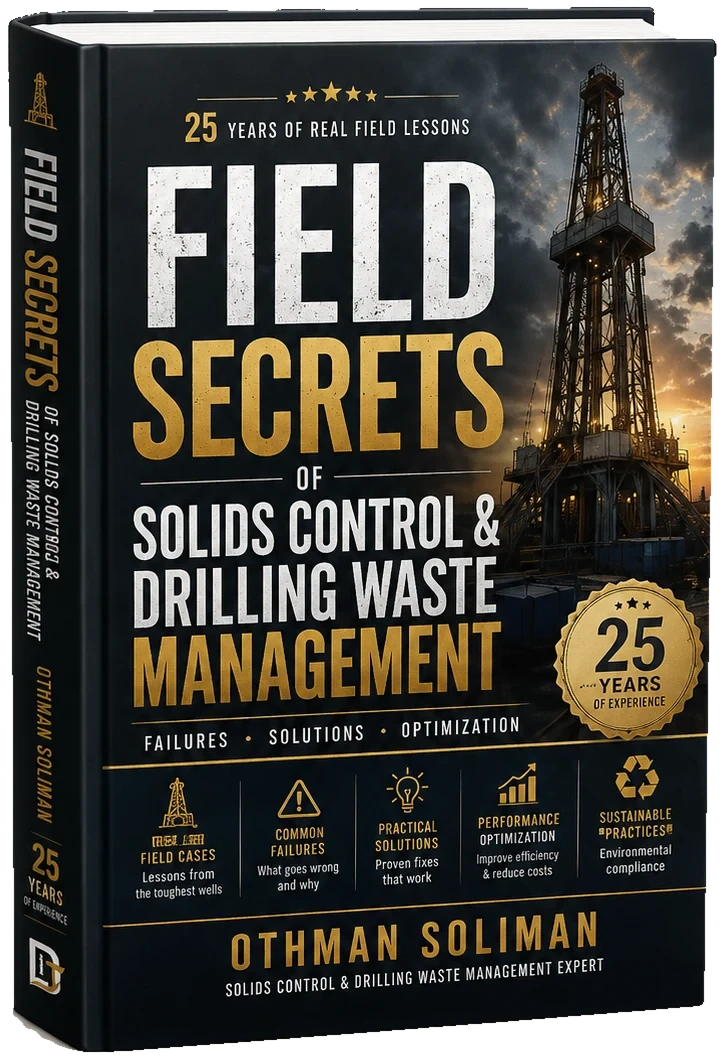
SC DrillTech is an independent, vendor-neutral solids-control and drilling-waste consultancy and technical reference founded by Othman Soliman. It helps rigs across the GCC and MENA lower dilution cost, recover fluid and stay compliant by evaluating shale shakers, hydrocyclones, centrifuges, the mud system and the waste circuit — measured, not guessed.
Got a live problem, not just a question?
Field Doctor reads your symptom against 199 documented failure modes and ranks the likely causes — free.
Open the Common Failure Center →Maintained by SC DrillTech · independent & vendor-neutral · grounded in API RP 13B/C/D and field practice.