
RIG IQ
Run this on your shift data
Live calculations, interpretation and report-ready output.
Open Rig IQ →When a completion brine comes back loaded with solids, you don’t run it straight at cartridges — you’d blind them in minutes and burn through a fortune in elements. The filter press is the workhorse that strips the bulk solids first, so everything downstream has a fighting chance.
The filter press is a plate-and-frame unit that runs diatomaceous-earth (DE) filtration to pull the bulk of the solids out of a dirty brine at high throughput. It’s the first heavy-duty stage of the train: take the gross load off, so the fine cartridge stage only has to polish.
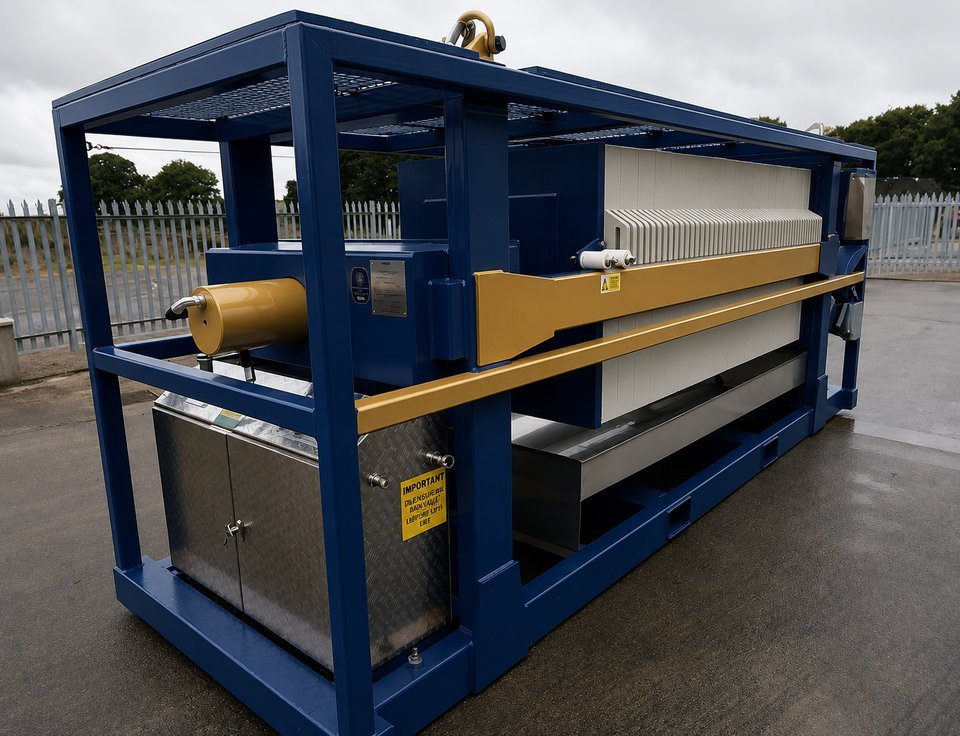
Diatomaceous earth is a fine, porous filter aid. The press first lays down a thin precoat of DE on the septa, then meters DE into the incoming brine as body feed. As the fluid passes, the DE keeps building a fresh, permeable cake that traps solids while still letting brine through — which is how the press handles heavily contaminated fluid without instantly plugging. DE media retention typically lands around 2–5 micron.
The press is the bulk-removal stage. In a classic two-step completion train, dirty brine goes through the DE press (or a vertical pressure leaf) first, then to a dual-vessel cartridge unit for the final polish to NTU spec. On smaller jobs the press may be skipped and a cartridge/bag unit run stand-alone — but for a heavy solids load, the press is what makes the economics work.
DE filtration is high-throughput, but it has one catch: the press can release fine DE particulate into the filtrate. That’s exactly why a cartridge unit is run downstream as a guard — to catch any DE breakthrough before the brine goes to the clean tank. Treat the press and the cartridge stage as a pair, not as alternatives.
A good run comes down to a clean precoat, the right body-feed rate for the solids load, and watching differential pressure — rising differential tells you the cake is loading and a cycle is coming. Push it too hard and you get DE in the filtrate; starve the body feed and the cake blinds early. The art is keeping the cake permeable for as long as possible.
| Type | Plate-and-frame, DE filtration |
| Role | Bulk solids removal (first stage) |
| DE retention | ~2–5 micron |
| Media | Precoat + body feed |
| Downstream | Cartridge guard / polish |
| Watch | Differential pressure · DE breakthrough |
The filter press isn’t the finish line — it’s what makes the finish line affordable. Strip the bulk solids on DE, guard the breakthrough with cartridges, and you reach NTU spec without drowning in element cost. Stage the work; don’t ask one filter to do the whole job. Measured, not guessed.
If a completion job is coming with a heavy solids load, a remote review can size the press-plus-cartridge train so you hit clarity without runaway consumable cost.
Request a remote evaluation More field articlesGrounded in field completion-fluid practice and API RP 13J clarity testing. Media, rates and configurations vary with the job — treat values as engineering guidance.
The 10 Solids-Control Numbers Every Engineer Must Track — what to measure, the formula, the field target and the red flag. Grounded in API RP 13B-1, RP 13C, EPA 40 CFR 435 & OSPAR.

Live calculations, interpretation and report-ready output.
Open Rig IQ →Independent review · confidential · on-site or remote.
Request an evaluation →