
RIG IQ
Run this on your shift data
Live calculations, interpretation and report-ready output.
Open Rig IQ →The cartridge unit is where the brine finally gets to spec. It’s the last guard between your fluid and the formation — and the most misread piece of the train, because the rating on the box and the protection in the hole aren’t the same thing.
Cartridge and bag units carry out the final polish, taking a brine that’s already had its bulk solids removed and bringing it down to the target NTU and micron spec. They’re usually dual-vessel units — twin pods so you can switch elements without shutting the job down.
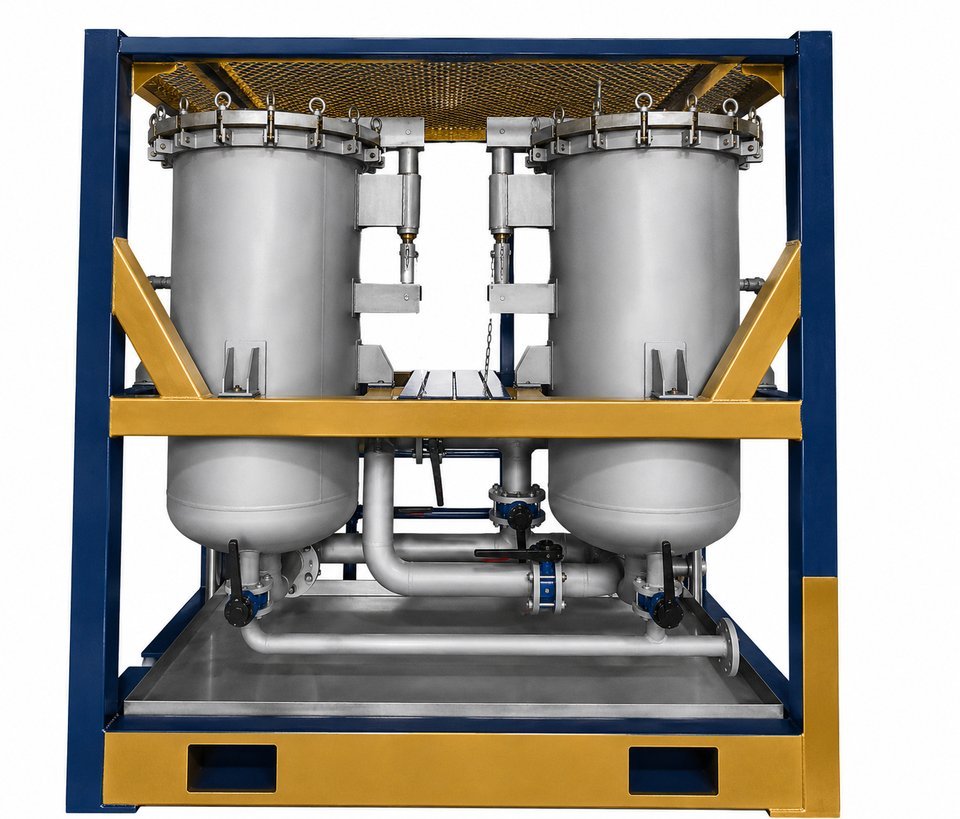
Cartridges are rated by pore size: 1, 2, 5, 10 and 25 micron, and that rating is either nominal or absolute. This is where jobs go wrong: a nominal 5-micron passes far more oversized particles than an absolute one. For formation protection you want Beta-rated cartridges — Beta 5000 or higher means 99.98% removal at the rating. A common completion polish runs 2 or 5 micron absolute, chosen for the formation.
Filter bags are typically nominal and coarser — cheap, high-capacity, good as a pre-filter ahead of the cartridges. Cartridges are the finer, absolute, formation-grade element. The standard move is to run them in series, coarse to fine: bag or coarse cartridge first to take the load, fine absolute cartridge last to hit spec. That sequencing is what keeps the expensive elements alive.
The twin-pod design is the workhorse of the brine site for a reason: small footprint, and it accepts bags and/or cartridges across a huge range — from a few millimetres down to about 0.5 micron. You can stage coarse-to-fine across the two vessels, or switch a loaded vessel offline and keep running on the other. It’s the most flexible, most economical piece of the train.
On a heavy solids load, the cartridge unit polishes after a DE filter press that did the bulk work. On small volumes or lightly loaded brine, a dual cartridge/bag unit is often run stand-alone — the flexibility and small footprint make it the economical choice when there isn’t enough solids to justify a press.
| Role | Final polish to NTU / micron spec |
| Cartridge ratings | 1 · 2 · 5 · 10 · 25 micron |
| Rating type | Nominal vs absolute (Beta-rated) |
| Formation-grade | Beta 5000 = 99.98% removal |
| Bags | Coarser, nominal, pre-filter |
| Range | mm down to ~0.5 micron |
The rating on the cartridge box is a starting point, not a guarantee. Run bags coarse-to-fine into Beta-rated absolute cartridges sized for the formation, and the unit does what NTU alone can’t — it removes the particle size that damages the rock. Stage it, and the elements last; skip the staging, and you blind the expensive ones first. Measured, not guessed.
If you want the cartridge train and ratings matched to the formation and the brine you’re running, a remote review can set the stages before you order a single element.
Request a remote evaluation More field articlesGrounded in field completion-fluid practice and API RP 13J clarity testing. Ratings and staging vary with formation and brine — treat values as engineering guidance.
The 10 Solids-Control Numbers Every Engineer Must Track — what to measure, the formula, the field target and the red flag. Grounded in API RP 13B-1, RP 13C, EPA 40 CFR 435 & OSPAR.

Live calculations, interpretation and report-ready output.
Open Rig IQ →Independent review · confidential · on-site or remote.
Request an evaluation →