Drilling Fluids Fundamentals
The properties that keep a well drilling — and how almost every one of them is really a solids-control scorecard. The fundamentals a mud or solids-control engineer reads every shift, framed toward where SC DrillTech lives.
1What drilling fluid does
Drilling fluid is the most multi-tasked material on the rig. Before anything else, it has to do several jobs at once:
- Carry cuttings out of the hole and suspend them when circulation stops.
- Control formation pressure — the hydrostatic column is the primary well-control barrier.
- Cool and lubricate the bit and string.
- Stabilise the wellbore — chemically and through a thin, sealing filter cake.
- Transmit hydraulic energy to the bit and any downhole tools.
Every property you measure is really a check on one of these jobs — and almost all of them are degraded by the same thing: drilled solids the system fails to remove. That is the thread that ties drilling fluids to solids control.
2Mud systems — WBM, OBM & synthetic
Mud systems fall into three broad families, chosen for the formation, the environment and the cost of disposal:
| System | Base | Where it fits |
|---|---|---|
| Water-based (WBM) | Fresh / brine water | Most common, lowest disposal cost, widest chemistry |
| Oil-based (OBM) | Diesel / mineral oil | Shale stability, high temperature, lubricity |
| Synthetic / NAF (SBM) | Synthetic base fluid | OBM performance with a better environmental profile |
On non-aqueous fluids (OBM/SBM) the base fluid is expensive and the discharge is regulated, so every barrel lost on the cuttings is both a cost and a compliance issue — which is why the cuttings dryer and tight solids control matter most there.
3Key properties at a glance
A handful of properties tell you almost everything about the fluid’s health. These are the numbers on every daily mud report:
| Property | What it measures | Watch for |
|---|---|---|
| Mud weight | Density / hydrostatic control | Sag, gas-cut, barite balance |
| PV (plastic viscosity) | Mechanical friction — mostly solids | Rising = fine-solids load building |
| YP (yield point) | Carrying capacity / gel structure | Too low = poor hole cleaning |
| Gels (10s/10m) | Suspension at rest | Flat = sag risk; high = ECD spikes |
| Retort (oil/water/solids) | Solids & liquid volumes | Total solids, LGS vs barite split |
| MBT | Reactive clay (CEC) | Rising = colloidal drilled solids |
| Sand content | Coarse abrasives > 74 µm | Equipment wear, shaker bypass |
| API fluid loss | Filter-cake quality | High = thick cake, differential sticking |
Notice how many of these point straight back at solids — PV, retort, MBT and sand are, in effect, solids-control scorecards in disguise. See the PSD Knowledge Center for the size dimension behind them.
4Rheology — PV, YP & gels
Drilling mud is a Bingham plastic: unlike water, it needs a minimum stress just to start moving. Plot shear stress against shear rate and two numbers fall out — the slope and the intercept.
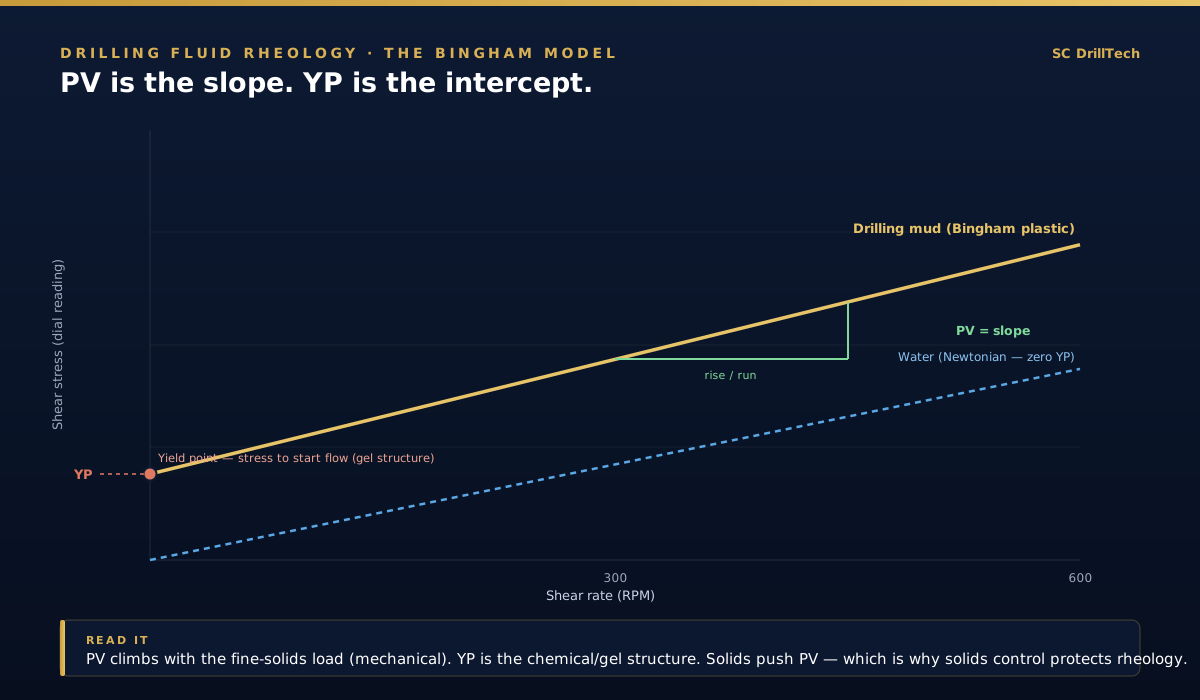
- PV is mechanical — it rises with the count of fine solids in the fluid. A climbing PV usually means the removal train is slipping.
- YP is the gel structure that carries cuttings — mostly chemistry, tuned with the mud system.
This is the cleanest way to see why solids control is rheology control: you manage YP with chemistry, but you only manage PV by removing solids. See PV & YP explained.
5Solids in the mud — barite vs LGS
Two solids share the mud and behave like opposites:
| Barite (weight material) | Low-gravity solids (LGS) | |
|---|---|---|
| Specific gravity | ~4.2 | ~2.6 |
| You want it | Yes — you paid for density | No — drilled waste |
| Effect on PV/ECD | Controlled | Drives both up as it grinds finer |
The whole art of solids control is to remove the LGS while keeping the barite — which is exactly why a mud cleaner exists, and why a centrifuge has two opposite duties. Get this split wrong and you either discard weight material or let fine LGS strangle the rheology. See LGS & the retort and barite & sag.
6Mud weight, ECD & barite sag
Mud weight is the hydrostatic barrier, but the formation feels ECD — equivalent circulating density — which is mud weight plus the friction of pumping it. The fine-solids load raises ECD through PV, which is the bridge to lost circulation.
Barite sag is the other side: if suspension fails (flat gels, low-side wells), heavy barite settles, and you get alternating light and heavy mud — a well-control hazard. Sag is a suspension problem, and suspension is a properties problem kept healthy by the right solids balance. See ECD & solids load and the Lost Circulation Center for where rising ECD ends.
7Testing the mud (API RP 13B)
The daily check is standardised so any engineer reads the same number the same way (API RP 13B-1 for water-based, 13B-2 for non-aqueous):
- Mud balance — density.
- Rotational viscometer — the 600/300 dial readings that give PV and YP, plus gels.
- Retort — oil / water / solids by volume; the basis for the LGS split.
- Filter press — API fluid loss and cake thickness.
- MBT (methylene-blue) — reactive-clay content.
- Sand content kit and a Marsh funnel for quick field checks.
These tests are also exactly what a remote evaluation reads — the mud report is the window into how well the solids-control train is doing its job.
8Why fundamentals matter for solids control
Drilling-fluid properties are the scoreboard; solids control is how you keep the score. PV, retort, MBT and sand all move with the drilled-solids load — so a clean removal train is what keeps the mud in spec, the ECD down and the dilution bill small. Fundamentals here, mechanics in the equipment guides, size in PSD, consequences in Lost Circulation.
→Go deeper
Want your mud report read like a solids-control scorecard?
Send your daily mud and retort data — SC DrillTech will tell you what your PV, MBT and sand are really saying about the removal train.
Put these numbers to work on your rig
Send your shift data — we read it against API RP 13C and tell you exactly what to change.
Request a remote evaluation →