Lost Circulation Center
Practical guidance on diagnosing mud losses, selecting LCM, and understanding the relationship between lost circulation, drilling fluids, and solids-control systems.
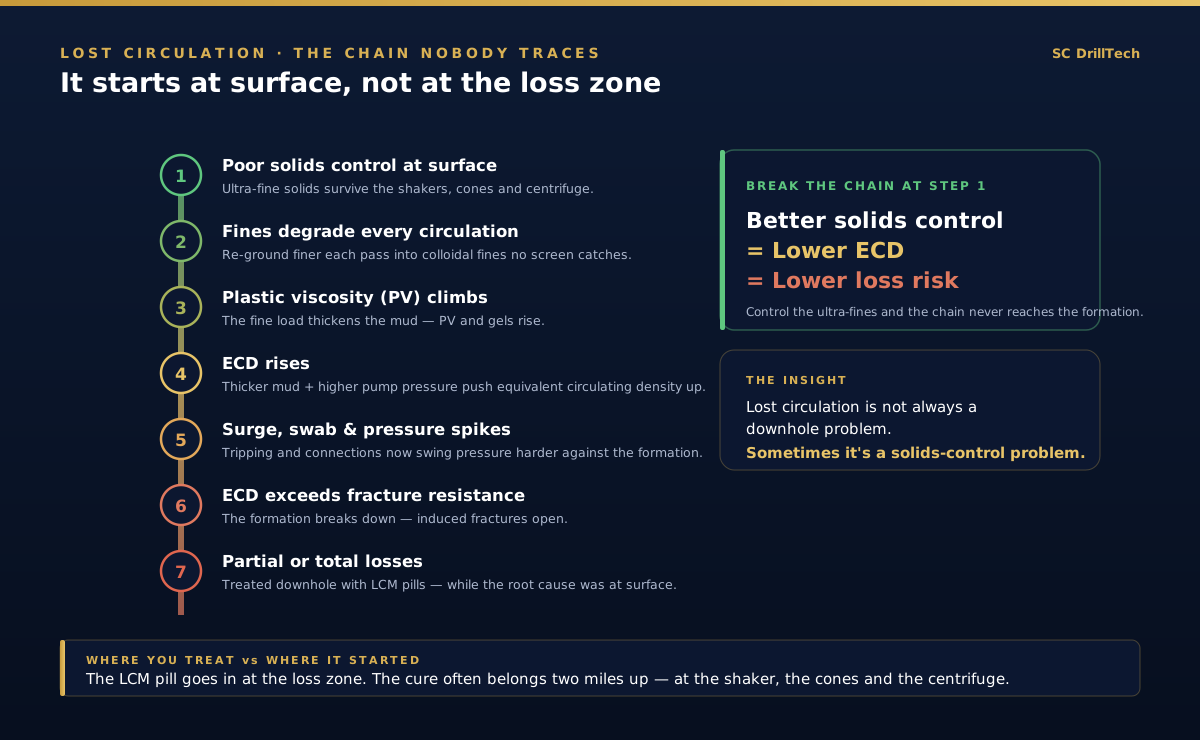
Lost circulation is not only a drilling problem. Poor solids-control decisions can increase mud losses, waste valuable LCM, and significantly raise well costs. This center looks at losses from the angle SC DrillTech knows best — the surface system.
1What is lost circulation?
Lost circulation is the loss of whole drilling fluid from the wellbore into the formation — fluid leaving through fractures, vugs or permeable rock, not filtering through a cake. It is measured by what the pits lose, in barrels per hour.
Losses vs fluid loss — don’t confuse them. Fluid loss (API filtrate) is the small, controlled seepage of liquid through the filter cake, measured in mL. Lost circulation is whole mud — solids and all — disappearing into the formation. One is a cake-quality number; the other is a returns problem.
Operational impact: lost hydrostatic head (well-control risk), lost expensive fluid, non-productive time, and in severe cases an inability to keep the hole full. It is one of the costliest events on a well.
2Types of lost circulation
Losses are graded by rate, because the rate decides the response:
| Type | Typical rate | Symptom & impact |
|---|---|---|
| Seepage | < ~10 bbl/hr | Slow pit drop; often permeability or near-balance — manage with fine LCM/sweeps. |
| Partial | ~10–50 bbl/hr | Clear, steady pit loss with returns still at surface — LCM pills, monitor ECD. |
| Severe | > ~50 bbl/hr | Heavy loss, reduced returns — coarse LCM, pills, slow the pumps. |
| Total | No returns | No fluid back at surface — hole may not stay full; well-control priority. |
These numerical bands are a common field convention, not a universal API threshold. Apply the approved well-program definitions and document rate, cumulative volume, trend and operating condition. Read the full severity-classification guide →
3Common causes
Where the fluid goes tells you what you are fighting:
- Natural fractures — pre-existing open fractures that take fluid as soon as they’re intersected.
- Induced fractures — the well breaks the rock itself when ECD exceeds the fracture gradient. This is the one solids control influences most directly.
- Cavernous / vugular formations — karst, caverns and large voids that can take total losses instantly.
- Highly permeable zones — coarse sands and gravels that drink fluid through pore space (seepage to partial).
- Weak / depleted formations — low fracture resistance, easily induced once pressure creeps up.
Note the pattern: two of these — induced fractures and weak formations — are pressure-driven, and pressure is driven by ECD, which is driven by the fine-solids load. That is the SC DrillTech angle.
4Field diagnosis guide
You rarely see the loss zone — you read it from surface signs. Four signals, read together, grade the loss:
| Signal | What it shows |
|---|---|
| Pit volume trend | The primary measure — rate and shape of the active-pit drop = the loss rate. |
| Flow show (flowline) | Returns reduced vs none = partial vs total; the flow-out paddle confirms. |
| Standpipe pressure | A drop can signal losses (and U-tube); rising ECD before a loss is the warning. |
| Mud properties | Climbing PV/ECD ahead of an event points to a fine-solids cause, not just the formation. |
Read all four on one synchronized timeline. Bit depth at first detection is not automatically the thief-zone depth; any exposed open-hole interval may take fluid. Use the loss-zone identification workflow →
5Lost circulation & solids control
This is where SC DrillTech has something few others say. The solids-control system can either protect you from losses — or quietly make them worse and waste the LCM you’re paying for.
LCM & shale shakers
The shaker is where LCM is won or lost. Run normal screens during an LCM treatment and the deck screens out the very material you just pumped — throwing expensive fibres and flakes straight to waste. The response must be engineered around both LCM retention and drilled-solids control. A dedicated LCM-recovery/scalping arrangement is preferred where available; any temporary screen or flow-path change must follow the approved treatment because blanket bypass can load the mud with drilled solids and raise ECD. See the shaker guide and screen blinding.
LCM & mud cleaners
The mud cleaner’s fine screen will also reject coarse LCM. During treatment, know when to bypass the cones / cleaner so the LCM isn’t classified out — then return to normal once the pill is placed. It’s an operational decision, not a set-and-forget. See the mud cleaner guide.
LCM & centrifuges
A centrifuge running through an LCM treatment can strip out the sized material you need in suspension, and load itself with fibrous solids it was never meant to handle. The recommendation: idle or isolate the centrifuge during active LCM work, and resume once the treatment has done its job. See the centrifuge guide.
LCM recovery & reducing unnecessary losses
Beyond protecting the pill, the bigger prize is not generating the problem: controlling ultra-fine drilled solids keeps PV and ECD down so you induce fewer losses in the first place. Better solids control upstream means fewer LCM events downstream.
Common solids-control mistakes during a loss event
- Leaving fine screens on the shaker — screening out the LCM you just bought.
- Running the centrifuge through the treatment — removing sized material from suspension.
- Forgetting to bypass the cones / mud cleaner during the pill.
- Letting LGS and PV climb unchecked — raising ECD until the formation breaks.
- Not restoring normal solids control after the pill — leaving the system half-configured.
6LCM categories
LCM is grouped by particle shape, because shape decides how it bridges and seals. An overview — sizing and selection are an expanding topic here:
| Category | Purpose | Typical application |
|---|---|---|
| Fibrous | Span and mat across openings | Seepage to partial; builds a base for other LCM |
| Flaky | Lay over and cover the face | Permeable zones and fractures; surface sealing |
| Granular | Bridge and plug at the throat | Wider fractures; the structural bridging particle |
Effective pills often blend all three — granular to bridge, fibrous to span, flaky to seal. Detailed selection and sizing are flagged below as coming soon.
7Economic impact
Losses are expensive on more than the fluid line. A single event compounds across the cost sheet:
- Lost mud — every barrel into the formation is barrels of base fluid and chemicals gone.
- Extra dilution & build — rebuilding lost volume, often the most expensive lever.
- Extra waste — more volume to treat and haul, especially on NAF.
- Logistics — LCM, barite and base-fluid resupply, sometimes by boat or air.
- Rig time — NPT chasing the loss is usually the biggest number of all.
Simple example: a partial loss of 30 bbl/hr on an OBM at a fully-loaded cost of a few hundred dollars a barrel runs into five figures a day before a single hour of NPT — which is why prevention at surface (controlling ECD via solids) pays for the whole solids-control effort many times over.
8Future expansion
Where this center is growing
Version 1 establishes the topic from the solids-control and drilling-fluids angle. Planned next:
?FAQ
Is lost circulation a solids-control problem?
Why does the shaker waste LCM?
Should I run the centrifuge during an LCM treatment?
What’s the difference between lost circulation and fluid loss?
→Connected across SC DrillTech
Losing returns and chasing it downhole?
Before the next LCM pill, let SC DrillTech check whether your fines load is feeding the problem — a remote review of your PV/ECD trend, PSD and solids-control performance.
Put these numbers to work on your rig
Send your shift data — we read it against API RP 13C and tell you exactly what to change.
Request a remote evaluation →