
Rock generated is not rock received.
Formation volume, transport, arrival time and particle change. Match the drilling interval to what reaches the surface before comparing records.
SC DrillTech · Engineering framework
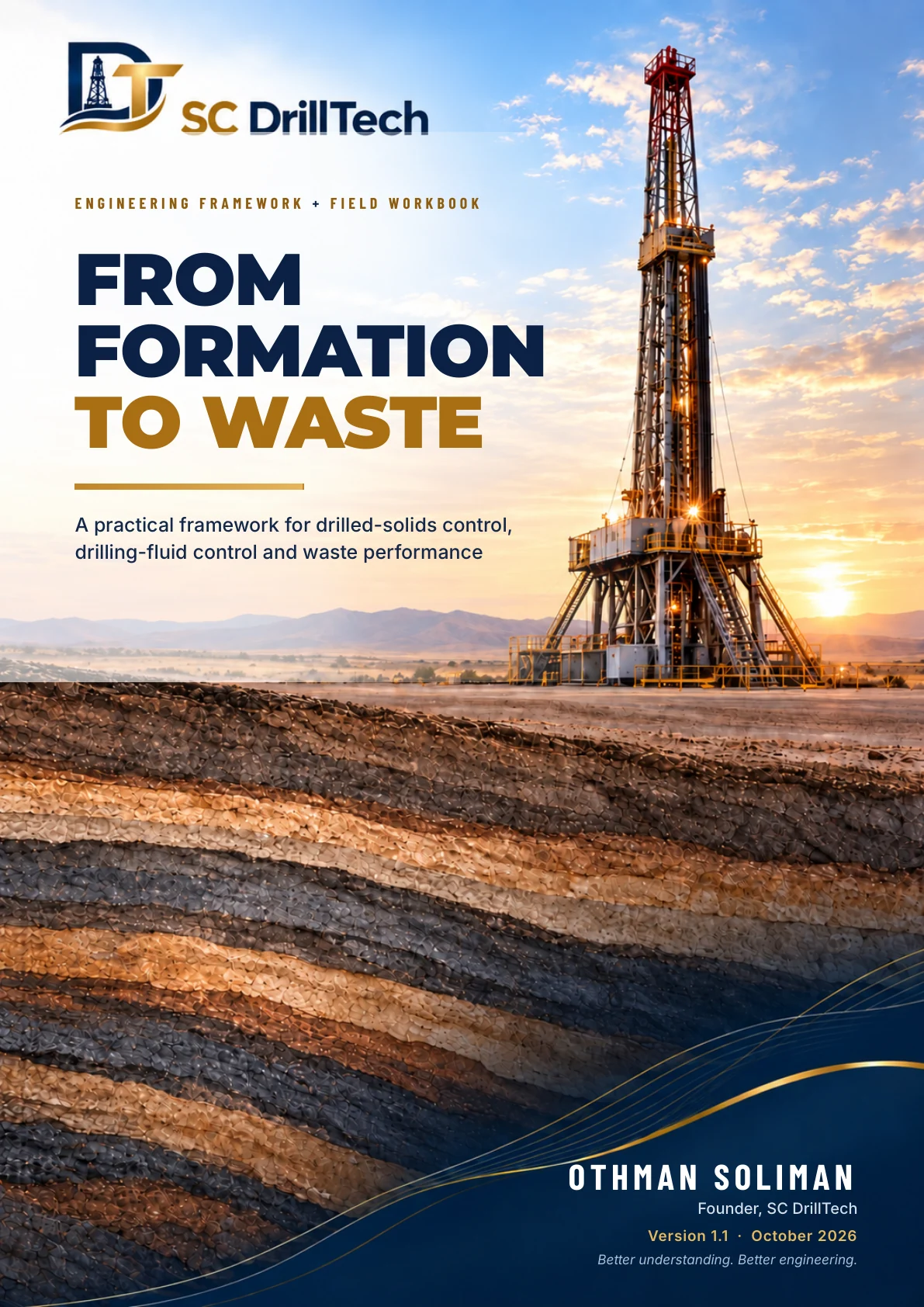
A practical framework for drilled-solids control, drilling-fluid control and waste performance.
Where did the drilled solids go, and what did it cost to manage them?
Follow the material from formation to its actual destination. Put the records on the same clock. Then test the explanation before changing the system.
Version 1.1 · Free PDF · 57 pages
Why I wrote it
A mud report can look stable while the system is working harder and costing more. Make-up, discard, retained solids and waste can move in the wrong direction without one property telling the whole story.
“So I do not start by blaming a machine. I trace the material first, then test the explanation.”
This framework connects Solids Control, Drilling Fluids Control and Drilling Waste Management through one operating window. It helps the team explain what the records show, what they do not show, and what needs to be measured next.
Inside the framework
Formation volume, transport, arrival time and particle change. Match the drilling interval to what reaches the surface before comparing records.
Retort interpretation, solids estimates and the Conditional Dilution Trap. Three dilution models show why the assumptions change the answer.
PSD, separation curves, matched sampling and device balances. Use equipment calculations as checks; do not substitute a nameplate for field evidence.
Dry-solids mass and fluid volume, SRE, SREopt and MCR. Worked examples make the measurement basis, assumptions and uncertainty visible.
Recovery boundaries, waste routes, retained-fluid reporting and costs. Regulatory examples keep the method and reporting basis beside the number.
Protocols A–E, an audit checklist, workshop exercises and blank sampling and decision records. Record who acts, what stops the test and when to check back.
Go deeper: The solids-control mass balance · Solids-control cost per foot · Technical training. The full workbook includes the method, assumptions, limits, and records to test it against an operating interval.
A practical starting point
Start with the actual route, including bypasses and discharge destinations. Keep raw readings and their units. Compare samples only when their timing and basis are compatible.
If the evidence is incomplete, the useful result is a specific measurement request. One number should start an investigation, not trigger a machine change.
Discuss a rig evaluationSolids-control engineers, mud engineers, drilling engineers, supervisors, drilling-waste teams, technical support personnel and instructors who need to connect equipment observations with system performance.
Put the method to work
Use the balances, sampling records and worked cases in an agreed classroom, workshop or rig-based program.
Review actual routes, equipment duties, fluid losses and waste records. Identify the evidence needed before recommending a change.
Explore SC DrillTech’s engineering platform for related calculations and evaluation work. Check each tool’s inputs and assumptions.
The author
Founder of SC DrillTech, with more than a quarter century of field and technical experience in solids control and drilling waste management.
His work includes rig evaluation, installation and commissioning, troubleshooting, technical support, project supervision and training program development.
Keep reading
The framework brings the system together. SC DrillTech’s articles, equipment library and troubleshooting resources let you examine individual duties in more detail.
Yes. The complete V1.1 PDF is free. Enter your email on this page to unlock the download. Edition and training updates are optional and off by default.
No. Equipment duty, fluid, feed conditions and site limits matter. The method helps you establish the basis for a decision rather than copy a setting from another operation.
Contact SC DrillTech to discuss participants, equipment, practical access and learning objectives. Instructor-led delivery and any licence to reuse training materials are agreed separately.
This page links to Rig IQ for related engineering work. It does not claim that a complete Formation-to-Waste workflow is currently implemented.
Free technical publication · Registration
57-page PDF: engineering framework, worked balances, sampling protocols, uncertainty checks and printable field worksheets.
Version 1.1 · October 2026 · No payment required.
Free access
Enter your email below and download immediately. Updates are optional.
Only your email address is needed. The download opens right after you register.
Your email is stored privately on this website's hosting. We do not sell registration data. To access or delete your record, email support@scdrilltech.com.
Suggested citation
Soliman, O. (2026). From Formation to Waste: SC DrillTech Engineering Framework + Field Workbook (Version 1.1). SC DrillTech.
Want to discuss a training program or your operation? Contact Othman Soliman.
Better understanding. Better engineering.